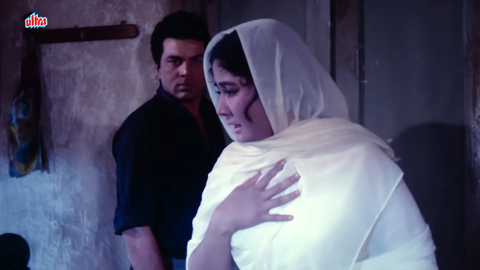
A couple of years back, I watched (and later reviewed) the Meena Kumari-Dharmendra starrer, Bahaaron ki Manzil. A good suspense thriller, it put me in mind of another film starring these two: Phool aur Patthar. I had seen the film many years ago, as a child (implication: this would have been in the early 80s, when Doordarshan’s sole TV channel was our only entertainment besides books and radio, which meant we watched anything that was aired, no matter how mediocre). I remembered nothing of it except that Dharmendra played a thief who ends up being cared for by Meena Kumari, playing a widow.
Continue readingTag Archives: Tuntun
Baaz (1953)
Today, July 9, 2025, marks the 100th birth anniversary of one of Hindi cinema’s best-known film directors. Born in Mysore on this day in 1925 as Vasant Kumar Shivshankar Padukone, Guru Dutt studied in Calcutta before joining Uday Shankar’s India Culture Centre (in Almora, present-day Uttarakhand) to train in dance. By the time he turned 19, he had moved to Pune, where he began working as a choreographer for Prabhat Studios. By the time Prabhat Studios folded up (in the early 1950s), Guru Dutt had formed a close friendship with Dev Anand, because of whom he received his first break as a director: in 1951, he directed Navketan’s Baazi, starring Dev Anand, Geeta Bali and Kalpana Karthik in a noir thriller that was to become a defining film for Navketan: edgy, stylish, dark, very urban.
Guru Dutt is today revered more for the hard-hitting, cynical cinema he made: films like Pyaasa, Sahib Bibi aur Ghulam and Kaagaz ke Phool hold up the mirror to a world that is selfish, cruel and opportunistic. These are bitter films, films that plumb the depths of human nature; films that—despite following most of the standard tropes of commercial Hindi cinema (a romance between the lead couple; a fair number of songs; a comic character invariably played by Johnny Walker)—were quite different from other Hindi films.
These, too, are the films for which Guru Dutt is mostly remembered today. Is that because over the decades, people have seen how the tragedy and turmoil of Guru Dutt’s personal life was probably reflected in films like these? Is there a voyeuristic tendency to try and spot the man behind the director?
But Guru Dutt also made other films, on other subjects. This one, for instance, an adventure/patriotic film set on the high seas, with Geeta Bali starring as the eponymous ‘Baaz’ (falcon), a woman who becomes a pirate to free her land of a colonial tyrant.
Continue readingUdan Khatola (1955)
Does Udan Khatola hold some sort of record for largest number of love/lust triangles?
Here’s a rough count:
There’s the unnamed aviator, the pardesi (played by Dilip Kumar) who is in love with the local peshwa’s daughter Soni. Who, in turn, loves him back.
Continue readingSapan Suhaane (1961)
Starring Balraj Sahni and Geeta Bali. With music by Salil Choudhary.
How could I—with a well-established reputation for watching films based on a single name I like among the crew and cast—pass up this one? Balraj Sahni is a favourite, as is Geeta Bali. And Salil Choudhary is one of those rare music directors for whom I’ll watch a film (even if I could just as well just listen to a playlist of the songs online).
These three were the reason I watched Sapan Suhaane, and I’ll admit that till more than midway through the film, I was congratulating myself on having stumbled on a hidden gem. Or, if not strictly a ‘gem’, at least a film that was watchable enough. After that…
But to start at the very beginning, when we are introduced to Shankar (Balraj Sahni) and his younger brother Dilip (Chandrashekhar). Shankar and Dilip are stepbrothers, but deeply devoted to each other. Shankar has given up his own comfort, his own prospects, in order to work so that he can finance Dilip’s studies.
Continue readingSadhu aur Shaitan (1968)
Cinema looking at itself is not an uncommon feature; there have been several notable films, both in India (Kaagaz ke Phool, Sone ki Chidiya) as well as abroad (Cinema Paradiso, 8½, The Bad and the Beautiful, etc), which are about cinema and film-making. But this film, relatively obscure, really should be part of the annals, simply because of its sheer devotion to Hindi cinema. Not because it’s about film-making, not because there is even (as in Solvaan Saal), a single scene on the sets of a film. But because it celebrates Hindi cinema in so many ways, on so many levels.
Sadhu aur Shaitan begins by introducing us to the eponymous ‘sadhu’ of the story: Sadhuram (Om Prakash), a widower who lives with his two children Ganesh (Master Shahid) and Munni (Baby Fauzia), and the maid Ramdeyi (Dulari) who looks after home and the children. Sadhuram is a somewhat excessively ‘good and righteous’ man, the living image of piety (all a little over the top as far as I’m concerned, but at least he isn’t stuffy about his righteousness).
Continue readingAakhri Dao (1958)
This was one film where I had a tough time making up my mind: should I review it? Should I not? It’s not a great film, but it’s not absolutely abysmal either. And it has a luminously lovely Nutan, plus some superb songs (courtesy Madan Mohan and Majrooh Sultanpuri) to compensate for other drawbacks in the film. It’s also a film about a murder (as macabre as that may sound, always something that catches my attention).
If for nothing else, as an example of a film that could have been pretty good but ends up a damp squib, this, I decided, was worth reviewing.
The story centres round Raj Kumar Saxena ‘Raju’ (Shekhar), a mechanic who works in a garage, and lives in a tiny room above the garage along with his friend and colleague Popat (Johnny Walker). Popat has been having a chat with a wealthy customer, Muthuswami Chetiyar (Mirajkar) and is keen on getting Muthuswami to invest in a garage for Popat. The incentive Popat offers is a match for Muthuswami’s daughter: Raju, he says, will be a fine bridegroom. Because he guesses Muthuswami will not be eager to marry his daughter to a mechanic, Popat takes care not to let on that the groom he has in mind is that figure hunched over a car at the other end of the garage…
Continue readingDil Ne Phir Yaad Kiya (1966)
It took me five days to watch this film: I couldn’t bear to watch more than fifteen minutes of it at a time, and I couldn’t do more than two sessions in a day.
That’s what Dil Ne Phir Yaad Kiya is like. Despite starring Dharmendra, Nutan, and Rehman. Despite being picturized in some very pretty locales. And despite having a couple of not-too-bad songs. By the time this travesty of a film ended, I was wanting to tear my hair out. I thought I wouldn’t review it, but then decided this did need to be reviewed, so that other potential viewers could be warned.
This is going to be a shortish review, since I can’t bring myself to explain every fiddly little detail along the way in what is a convoluted (but pointlessly convoluted) plot.
Ashok (Dharmendra) and Amjad (Rehman) are best friends. They live in the same pokey little flat (for which they haven’t paid the rent in a long time), they work in the same toy store, and they spend all their free time telling each other about their respective girlfriends. Ashok’s sweetheart is Ashu (Nutan), who lives back in the village and is constantly being plagued by Ashok’s nasty stepbrother Bhagat (Jeevan)…
Dil Diya Dard Liya (1966)
Despite its having a cast of several people whom I like a lot (Waheeda Rehman, Dilip Kumar, Pran, Rehman, Shyama), a music director whom I like a lot (Naushad) and being by no means an unknown film, Dil Diya Dard Liya is one I’d never got around to watching. Perhaps it is because I had been told by knowledgeable readers that it was based on Wuthering Heights—and I could imagine what a confluence of Wuthering Heights (dark, grim, with two thoroughly selfish and unlikeable leads) and typical Bollywood (melodramatic, with no lead capable of being anything but noble, even if it’s only in the final analysis)—would be like. Mishmash, hard to bear?
But when I posted a Naushad song list in tribute on Naushad’s birth centenary last year, several people mentioned the songs of Dil Diya Dard Liya, and I decided it was time to take the plunge. If for nothing else than Naushad’s music.
Talaash (1969)
There are a bunch of films that I’ve read a plot synopsis of, found it interesting, thought I’d try and watch it—and then taken a look at the cast, only to discover it starred someone I didn’t like. It’s happened time and again; with Talaash, having discovered that the film starred Rajendra Kumar, I decided to put the film on the back burner, even though the synopsis sounded interesting.
Then, reading Anirudha Bhattacharjee and Balaji Vittal’s SD Burman: The Prince Musician, and seeing the list of songs (some of them truly lovely ones), I thought I may be able to sit through the film. Perhaps the rest of the cast, the interesting story, and the good music, would compensate for Rajendra Kumar.
Talaash begins with the graduation of Raj Kumar ‘Raju’ (Rajendra Kumar), who is being congratulated by all his classmates for having once again come first in the class. Raju goes off to meet his friend Lachhu (OP Ralhan, who also directed this film, which was produced by Rajendra Kumar). Lachhu has, after seven tries, finally managed to graduate too. They congratulate each other, and talk briefly of their futures. Lachhu will be roped in to work at his wealthy father’s cloth shop; Raju doesn’t know what he’ll do, but he’s certain: the wealth of his family will only be doubled. Yes, he’s not known want, ever, and he will continue to enjoy all that wealth, now through his own hard work.
Ten of my favourite ‘Unusual Singer’ songs
By which I mean:
(a) That it’s the person who’s lip-syncing to the song (and not the playback singer) who’s unusual…
(b) and unusual because the actor in question is a well-known face, but doesn’t usually lip-sync to songs.
The idea for this post arose because of this wonderful post on Ashok Kumar’s songs, over at Ava’s blog. Ava drew attention to the fact that Ashok Kumar—one of the stalwarts of Hindi cinema, and with a pretty long stint as hero, too—rarely lip-synced to songs. In the post, another similar example was pointed out, in the case of Balraj Sahni: also a major actor, also a ‘hero’ in a lot of films, yet a man who didn’t lip-sync to too many songs.
That set me thinking of other people, other actors and actresses, who have rarely ‘sung’ songs onscreen. Not that they’re otherwise unknown; this is not a case of ‘Who’s that lip-syncing?’, but a case of people one generally doesn’t associate with doing too much singing onscreen. The leads of films (barring exceptions like Ashok Kumar or Balraj Sahni) are invariably excluded, because most songs end up being picturized on them. Major comedians, like Johnny Walker, Rajendranath, and Mehmood, also often had a comic side plot and a romance of their own, which allowed them to ‘sing’ often enough in films (have you ever seen a film that featured Johnny Walker and didn’t have him lip-syncing to at least one song?) And the dancers—Helen, Kumkum, Madhumati, Laxmi Chhaya, Bela Bose, et al—may appear in a film for only five minutes, but you could bet those five minutes would be a song.
Which leaves us with the somewhat more unusual people, the actors who played non-comic roles, character actors. Not stars, not dancers, not comedians. The Manmohan Krishnas, the Lalita Pawars, the other not-often-seen-‘singing’ characters. Here, then, are ten songs that are picturized on people not usually seen lip-syncing. As always, these are in no particular order, and they’re all from pre-70s films that I’ve seen.