Today marks hundred years of the birth of one of Hindi cinema’s finest directors: Hrishikesh Mukherjee was born on September 30, 1922, in Calcutta. Beginning in the late 1940s, Mukherjee worked as a film editor in Calcutta, before moving on to Bombay, where too he continued as editor, gradually moving on to direction as well. Mukherjee’s first film as director was Musafir (1957), and while it didn’t fare too well, it set the tone for a lot of Mukherjee’s later works: films about everyday people, with everyday triumphs and everyday sorrows. His were not the masala films that have always tended to dominate Hindi cinema, and yet—whether he was making classic comedies like Chupke-Chupke or Golmaal, or more nuanced, sensitive films like Majhli Didi, Satyakam, or Abhimaan, Hrishikesh Mukherjee made films that were hard to fault. He is one of the rare directors for whom I will watch a film just because it’s been made by this person.
Continue readingOne Voice, Two Faces: Ten of my favourite ‘one-singer-duets’
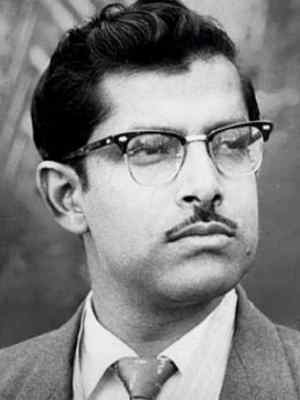
One playback singer sings for two (or, in some cases, more than two) people who lip-sync to the song onscreen. Within the same song, not two different versions of the song.
You’d have thought that wouldn’t be very common, given that a lot of our playback singers have had such distinctive voices that you wouldn’t expect two people in the same setting to be singing with that same voice. But then, reality and Hindi cinema have never been the best of friends; and anyway, there were probably other considerations: one singer is cheaper than two; it’s easier to get recording dates if you don’t have to juggle dates for two people; and all said and done, Hindi cinema is all about the willing suspension of disbelief. If three women (or four, or five) can all ‘sing’ in Shamshad Begum’s voice, so be it.
Continue readingThe LO Goes to Agra, Part – II
(For part I of this travelogue, click here).
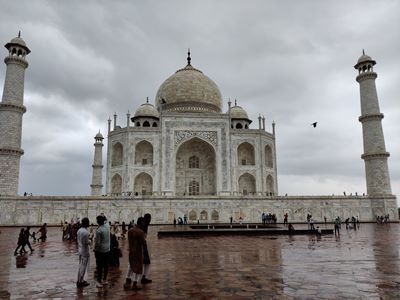
The next morning, we’d planned to go as early as possible to the Taj. This, given that the LO eats in a very leisurely style, meant that we eventually ended up leaving the hotel by around 8.30. It was a little cloudy at the time, but nothing, we thought, that might be a problem.
You can use fossil fuel transport till only outside a kilometre of the Taj; so our Ola taxi dropped us off, and we set off on foot, pursued hotly all the way by guides offering their services. We managed to fob them all off (we’ve been here several times before, and given that I did a lot of research on the Taj and Agra in general for my book Engraved in Stone, I do know a fair bit), and bought our tickets (Rs 200 per adult Indian if you want to go inside the mausoleum; Rs 50 if you’re content to see everything else but not enter the mausoleum).
Security, of course, is quite stringent, and this was where we ran up against an obstacle.
For the Agra trip, the LO had brought along a prized possession, a plastic tiara. This she insisted on wearing, in the fond belief that Mumtaz Mahal deserved a visit from someone dolled up like a maharani (never mind that the tiara didn’t quite match with the jeans, T-shirt, and Crocs the LO was clad in).
Continue readingThe LO Goes to Agra, Part – I
Some of you who’ve been following this blog over the past few years might know about the LO. The ‘Little One’, my now-nearly-nine year old daughter, has figured prominently in my travelogues over the past several years. She is an enthusiastic traveller, and few things bring her greater joy than to go to new places, stay at nice hotels (yes, a vital part of travel for the LO) and generally let her hair down.
Agra is a place we’ve been meaning to go for a while now. Of course the Taj Mahal is iconic, but there are several other wonderful old monuments in the city that my husband and I wanted to see again, and the LO, from seeing photos of the Taj in school textbooks and elsewhere, was eager as well. What’s more, the LO’s best friend has her nanihaal —her maternal grandparents’ home—in Agra. Every few months, the kid goes off to Agra, and of course tells the LO all about it.
Continue readingL’armata Brancaleone (1966)
Which is literally translated as The Army of Brancaleone, though this Italian film, directed by Mario Monicelli, was marketed to the English-speaking world as For Love and Gold.
Can one list, as a favourite, somebody whose work you’ve only encountered a few times? Is it necessary to view all (or most) of an actor’s films in order to be able to label them a ‘favourite’?
I think not. I hope not, because Vittorio Gassman is one I count among my favourites, even though I’ve watched probably not even ten of his films. And, given that today is Gassman’s birth centenary (he was born in Genoa on September 1, 1922), I decided it was a good day to show some Gassman love.
Continue readingBhoot Bungla (1965)
The last of the ‘silly Indian films’, at least for now.
I watched Bhoot Bungla for the first time as a child, when it was aired on Doordarshan. I remembered very little of it, except that RD Burman struck me as very funny (even funnier than Mehmood, who—back then—I had still not begun to think of as irritating). And that my mother, sitting beside me and watching Tanuja lip-sync to O mere pyaar aaja, remarked that she (Mummy) used to sing this song as a lullaby for my sister when she was a baby.
Then, when I reviewed Adhey Kangal some time back, a few blog readers observed that the plot was pretty similar to that of Bhoot Bungla.
Time, I decided, for a rewatch.
As the credits roll, an unidentified man screams “Lakshmi!” and having pulled a bloodied dagger out of his chest, proceeds to keel over, dead. A woman (Minoo Mumtaz), presumably Lakshmi, goes running out of the house, clutching a toddler to her, looking panicked.
Continue readingChalti ka Naam Gaadi (1958)
In response to that unwarranted comment about me ‘wasting my time watching silly Indian films’, I’ve done something (reviewed Bhabhi ki Chudiyaan and Devi) to uphold my contention that all Indian films are not silly. Now it’s time to look at Indian films which are silly, but where the silliness is intelligent, and deliberate.
What, after all, is wrong with silliness, or with humour? For me, the stuffy idea that humour is somehow low is very irritating. Some humour may be unpalatable to certain people (I, for one, find nothing humorous about sexist or racist jokes, or toilet humour), but humour can be sophisticated, it can be the result of a great intelligence.
As, I think, comes through in this delightful film about three brothers, all motor mechanics, who run a garage.
Brijmohan Sharma ‘Bade Bhaiya’ (Ashok Kumar), as he’s known, is the eldest of the three, and he rules with an iron fist in an iron gauntlet. Bade Bhaiya is a hard taskmaster, and lords it over Jagmohan ‘Jaggu’ (Anoop Kumar) and Manmohan ‘Manu’ (Kishore Kumar), as also their apprentice Maujiya (Mohan Choti). One important aspect of Bade Bhaiya’s personality is his aversion to women: he sees red even when Maujiya hangs up a calendar with a painting of a woman on it.
Continue readingDevi (1960)
When I posted on Twitter about the person who’d advised me to not ‘waste my time’ watching ‘silly Indian films’, a Twitter follower pointed out that Satyajit Ray was also Indian. And I had to concur: Ray, in fact, was the first person who came to my mind as a refutation of that ‘silly Indian films’ generalization. His films are works of art. Occasionally ‘silly’ (Goopy Gyne Baagha Byne fits there), but that silliness is on genius level. It takes brains and creativity to be silly in the way Ray was with that film.
But Devi, ‘The Goddess‘, is nothing like that. There is no silliness here, unless you interpret toxic superstition as silliness.
Continue readingBhabhi ki Chudiyaan (1961)
Some days back, a blog reader wrote to me (after having recommended several Hollywood films over the past weeks) to tell me that I was ‘wasting my time’ watching and reviewing ‘silly Indian films’.
I was initially too furious to be able to respond, but I eventually wrote back to say how unjustified and insulting this comment was. This, after all, is my blog. Nobody— not my family, not my friends, not the people who might be considered to have some sort of say—tells me what to watch. Recommendations, requests: more than welcome. Judgemental and rude remarks, no. You do not govern how I spend my time.
Once I simmered down a bit, I decided this called for a tribute to ‘silly Indian films’. So, for the duration of August 2022, I’m only going to be focusing on Indian cinema. Not one film from outside India is going to feature on Dustedoff all through this month.
So, to kick off ‘Silly Indian Film Month’, a review of a film I’ve been meaning to watch for a long time now.
Bhabhi ki Chudiyaan begins by introducing us to Mohan (Master Aziz), who lives with his elder brother Shyam (Balraj Sahni). Shyam and Mohan only have each other for family; their mother died giving birth to Mohan, and their father died a few months later. On his deathbed, he entrusted to Shyam the care and bringing up of Mohan. Shyam works as a clerk, and in order to be able to focus on Mohan’s education and upbringing, hasn’t even married. The two brothers somehow make do, but on days such as this—when Shyam has been too busy to make it to Mohan’s school function, where Mohan is getting various prizes—there is angst. Mohan is annoyed and tearful.
Continue readingJeevan Naiyya (1936)
While I knew of this film, I hadn’t paid enough attention to it until I read Nabendu Ghosh’s Dadamoni: The Life and Times of Ashok Kumar. Jeevan Naiyya, produced by Himanshu Rai and directed by Franz Osten (at a time when there were several European, especially German, technical experts in the Hindi film industry) is not a landmark film in itself, but simply viewed as Ashok Kumar’s first film, this is worth a watch.
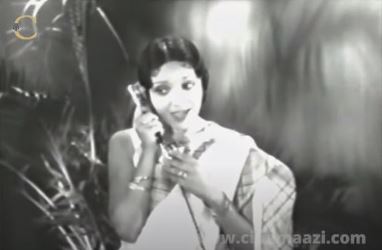
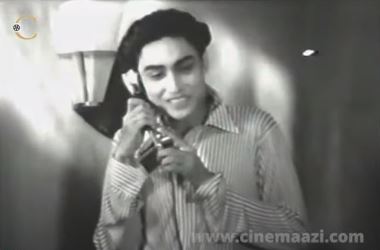
The story begins bang in the middle of things. Ranjit (Ashok Kumar) and Lata (Devika Rani) are engaged to be married, and the film begins with a telephone conversation in which they’re cooing sweetly inane nothings to each other. Ranjit’s boisterous friends barge in on this conversation and break it up, but it’s obvious that these two are very much in love with each other, and looking forward to being married.
Continue reading