Kaala Paani (1958)

Today is the 100th birth anniversary of one of my favourite Hindi film directors, the suspense-specialist Raj Khosla (I hasten to add: I am well aware that that’s a generalization, since Khosla made a lot of films, too, that had nothing to do with the thriller/suspense genre: Mera Gaon Mera Desh, for example; Chirag, Main Tulsi Tere Aangan Ki, Do Badan, etc). But it is Khosla’s prowess with this particular genre that I especially admire, a skill and talent he showcased in classics of the genre such as Woh Kaun Thi? ((1964), Mera Saaya (1966), CID (1956) and Kaala Paani (1958). In each of these films, he managed to combine the classic elements of the Hindi masala film—a romance, a comedic side track, lots of fabulous songs—while making sure that the suspense remained (mostly) taut, the mystery a solid one.

To commemorate Khosla’s birth centenary, I wanted to review one of his suspense films. Several of these (CID, Mera Saaya, Ek Musaafir ek Haseena, Woh Kaun Thi?) I have already reviewed; I was torn between some of the others: Solva Saal, Kaala Paani, and Anita, all of which I have seen at some time or the other. I decided, eventually, that it was time to rewatch Kaala Paani, a film that I’ve watched several times, but too far back to have reviewed it on this blog.

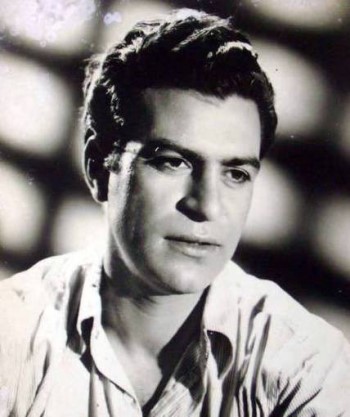
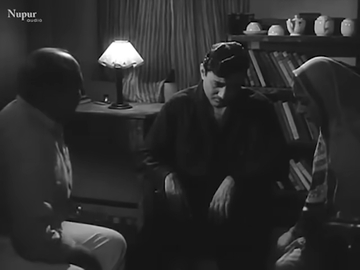
The story begins on a night in Bombay, with a woman (Mumtaz Begum) hurrying through the streets to the home of a family friend, Mr Kapoor (?). She is in great distress, and confides in Kapoor: Karan has discovered the truth. What this truth is we discover when Kapoor hurries to Karan’s home to find Karan (Dev Anand) sitting, looking bereft. He has found out (how, we aren’t told) that his father Shankar Lal has, for the past fifteen years, been incarcerated in Hyderabad jail for the murder of a tawaif named Mala. Not, as Karan has been led to believe all these years, dead.
Continue reading

Insaniyat (1955)

This is one film that’s been on my to-watch list for several years now, mainly because it is the only film that stars both Dev Anand and Dilip Kumar. Also, as I’ve gathered from a few articles and posts I’ve read, this is also possibly the only film that doesn’t feature Dev Anand as a modern city slicker. He’s still somewhat of a sophisticate—by no means an illiterate rustic—but this is set in some undefined ‘raja-rani’ time period where Dev Anand spends all the film in something other than Western clothing.

But, to begin at the beginning. Zangoora (Jayant) is a nasty tyrant whose idea of ruling his kingdom is to be brutal with his subjects. Every now and then, his soldiers are sent out into the countryside to loot villages and bring back all that they can find. Zangoora’s troops are vile, uncaring, as brutal as their boss.

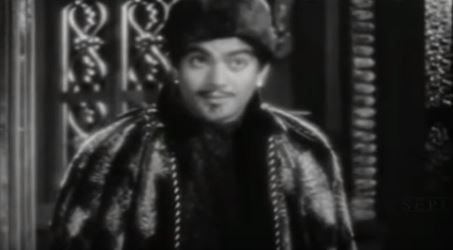
They’re at one village, upturning things, grabbing and snatching, when a furious village woman, Durga (Bina Rai) comes charging up. Durga lets fly at the man leading the troops, Bhanu Pratap (Dev Anand, his upper lip topped with a ridiculous moustache). Durga slaps Bhanu, and then proceeds to berate him for his mindless cruelty.

Continue reading

Aadhi Raat ke Baad (1965)

I dithered over this film for a long time after I’d finished watching it. Should I review it? Should I not? It wasn’t a great film, but it wasn’t terrible, either. It wasn’t as if a review was needed to warn potential viewers off it. Or vice-versa, to alert people to a film they must see.

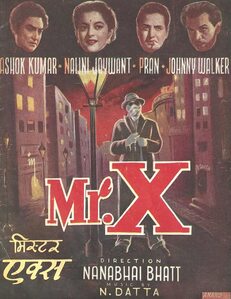
Eventually, I decided that at least a brief review was in order, because this film had an interesting connect to another film I’ve wanted to watch for a while: Mr X.

In 1957, Nanabhai Bhatt had directed a science fiction film (borrowing from HG Wells’s novel The Invisible Man) that starred Ashok Kumar and Nalini Jaywant. According to this web page on Mike Barnum’s blog, the film is about a man who ingests a drug that makes him invisible; he uses this invisibility to go on a Robin Hood-esque spree, helping the poor by robbing the rich. The cops, baffled by the invisible man, dub him Mr X.

I’ve long wanted to watch Mr X, mostly because it features one of my favourite N Dutta songs, Laal-laal gaal. The film isn’t available online, at least, or even on DVD, from what I can tell; perhaps there are carefully guarded prints deep in some archive…

Continue reading

Teen Bahuraaniyaan (1968)

I had read a review of this film on a blog years ago, but besides the fact that it starred Prithviraj Kapoor as the father-in-law of three women, I remembered nothing of what I’d read. Then, some weeks back, when Shashikala passed away, a couple of people remembered her role, as a popular film star, in this film. I was tempted to watch it.

The teen bahuraniyaan (the three daughters-in-law) live in one rambling house along with their husbands, their children, and their father-in-law Dinanath (Prithviraj Kapoor)a retired school teacher. The patriarch’s three sons, from eldest to youngest, are Shankar (Agha), Ram (Ramesh Deo) and Kanhaiya (Rajendranath). Appropriately enough, their wives, respectively, are Parvati (Sowkar Janki), Sita (Kanchana) and Radha (Jayanthi). Sita’s sister Mala (Vaishali), who’s come to town to do college, also lives with them.

Continue reading

Jigri Dost (1969)

Mostly, the films I review on this blog are either the ones I like so much I want more people to watch them; or films I hate so much I want to warn people off them. Or, sometimes, films which may not be otherwise exceptional but have, I think, something that sets them apart: they’re unusual, or they’re somehow of historic importance.

Now and then, along comes a film I decide I have to review because while I don’t find it dreadful, I wonder what it would have been like with a different cast. Even just one actor being replaced by another.

Jigri Dost begins in the palatial home of Chairman Neelkanth (KN Singh), who is a baddie of the first order. He summarily orders his henchmen to raze this bunch of poor people’s huts, extort money from that lot, and so on. He has no scruples, no mercy, no nothing… no inkling, either, that a maid (Aruna Irani) in his home eavesdrops on his every conversation.

Continue reading

Do Dulhe (1955)

Today is the birth centenary of one of a handful of Hindi film actors who managed to cross from one type of role to another—again and again. Like Ajit, Pran, and Premnath (though not in the same league as them, when it came to success and popularity), Sajjan Lal Purohit—better known simply as Sajjan—appeared in leading roles in several of his early films (including, notably, in Saiyyaan, where he acted opposite Madhubala), then drifted into supporting roles (as Dev Anand’s sculptor friend in Paying Guest; as Mini’s father in Kabuliwala; and more), and eventually into villainous roles (in April Fool, Aankhen, Farz, etc).

Continue reading

Suvarna Sundari (1958)

If you’ve been reading this blog for a while, you probably know that I cannot resist good music; so much so that there are plenty of films I’ve watched just because they happened to have one song which I like a lot. Many of these films have turned out to be complete duds, not at all worthy of the wonderful song which drew me to it—but I do not, in this case, subscribe to the ‘once burnt, twice shy’ philosophy. I go on doing it, often with painful results.

Suvarna Sundari, which I watched for Kuhu kuhu bole koyaliya, will however remain one of the exceptions. A stellar song, but also a very entertaining film.

The story begins in a gurukul, where Prince Jayant of Malwa (Akkineni Nageshwara Rao, ‘ANR’) is about to graduate and go back to Malwa to be declared crown prince. At the prospect of Jayant’s departure, his guru’s daughter (?) gets all het up and confesses her love for him. Jayant, being a good and upright man who knows his guru’s daughter is out of bounds for him, sternly refuses…

Continue reading

Pyaar Kiya Toh Darna Kya (1963)

For those who’ve been following this blog since pretty much its inception, or who’ve explored some of the older posts and specials on Dustedoff, it should come as no surprise that I am a fan of Shammi Kapoor. I have seen most of the star’s films from after his watershed year of 1957 (which was the year Tumsa Nahin Dekha was released, catapulting him to sudden stardom), and I’ve seen several from the early 1950s as well.

Finding a 60s (or late 50s) Shammi Kapoor film that I’ve not seen before is therefore a matter of singular excitement [or was; I have begun to realize, after several less than enjoyable experiences, that there is a reason most of these films aren’t better-known]. This time, when I came across Pyaar Kiya Toh Darna Kya, I approached it with caution. Pandit Mukhram Sharma’s name among the credits bolstered my hopes somewhat; he wrote some good stories, so I began thinking this might not be too bad.

Continue reading

Ten of my favourite ‘Unusual Singer’ songs

By which I mean:

(a) That it’s the person who’s lip-syncing to the song (and not the playback singer) who’s unusual…

(b) and unusual because the actor in question is a well-known face, but doesn’t usually lip-sync to songs.

The idea for this post arose because of this wonderful post on Ashok Kumar’s songs, over at Ava’s blog. Ava drew attention to the fact that Ashok Kumar—one of the stalwarts of Hindi cinema, and with a pretty long stint as hero, too—rarely lip-synced to songs. In the post, another similar example was pointed out, in the case of Balraj Sahni: also a major actor, also a ‘hero’ in a lot of films, yet a man who didn’t lip-sync to too many songs.

That set me thinking of other people, other actors and actresses, who have rarely ‘sung’ songs onscreen. Not that they’re otherwise unknown; this is not a case of ‘Who’s that lip-syncing?’, but a case of people one generally doesn’t associate with doing too much singing onscreen. The leads of films (barring exceptions like Ashok Kumar or Balraj Sahni) are invariably excluded, because most songs end up being picturized on them. Major comedians, like Johnny Walker, Rajendranath, and Mehmood, also often had a comic side plot and a romance of their own, which allowed them to ‘sing’ often enough in films (have you ever seen a film that featured Johnny Walker and didn’t have him lip-syncing to at least one song?) And the dancers—Helen, Kumkum, Madhumati, Laxmi Chhaya, Bela Bose, et al—may appear in a film for only five minutes, but you could bet those five minutes would be a song.

Which leaves us with the somewhat more unusual people, the actors who played non-comic roles, character actors. Not stars, not dancers, not comedians. The Manmohan Krishnas, the Lalita Pawars, the other not-often-seen-‘singing’ characters. Here, then, are ten songs that are picturized on people not usually seen lip-syncing. As always, these are in no particular order, and they’re all from pre-70s films that I’ve seen.

Continue reading

Baadal (1951)

The last Hindi film I’d reviewed was the Sanjeev Kumar swashbuckler Baadal. When I’ d begun watching that, I wondered briefly if it would be a remake of the Premnath Baadal, a film I’d seen too long back to remember much of. As it happened, while the later Baadal did borrow some of the basics—the rebel hero who falls in love with a noblewoman whom he should probably be hating instead—it is actually a very different film. Premnath’s Baadal, for one, is no poet, and instead of borrowing from The Three Musketeers, this Baadal is explicitly stated as having been inspired from Robin Hood.

Continue reading