Aaye Din Bahaar Ke (1966)

(Coincidentally enough, I watched Aaye Din Bahaar Ke some weeks back, just after I’d posted my review of Phool aur Patthar. Back then I’d not known that we would be mourning the passing of Dharmendra so soon after. Consider this a tribute).

When I watched Phool aur Patthar some weeks back, I was reminded of the many fairly entertaining films Dharmendra worked in through the mid- and late-1960s. Not all of them were good (some, like Chandan ka Palna, were terrible), but quite a lot of them had at least good songs, a fair deal of entertainment value, and an undeniably handsome male lead to make them worth at least a one-time watch. Some of these (like Aankhen, arguably my favourite Dharmendra film) I’ve reviewed already; there are several others.

Here’s one. I last watched Aaye Din Bahaar Ke perhaps about 20-odd years ago, and actually remembered a fair bit of it. That I didn’t mind watching it again, even though the film is far from perfect, says a lot for it.

The story begins in Darjeeling, where Ravi (Dharmendra) lives with his widowed mother (Sulochana Latkar). Ravi is devoted to his mother: so much so that when Ma is doing her pooja, he tells her, “You may worship your gods, but I will worship only you.” She has devoted her life to looking after Ravi, educating him, etc, which is why this somewhat OTT sentiment.

Continue reading

Sapan Suhaane (1961)

Starring Balraj Sahni and Geeta Bali. With music by Salil Choudhary.

How could I—with a well-established reputation for watching films based on a single name I like among the crew and cast—pass up this one? Balraj Sahni is a favourite, as is Geeta Bali. And Salil Choudhary is one of those rare music directors for whom I’ll watch a film (even if I could just as well just listen to a playlist of the songs online).

These three were the reason I watched Sapan Suhaane, and I’ll admit that till more than midway through the film, I was congratulating myself on having stumbled on a hidden gem. Or, if not strictly a ‘gem’, at least a film that was watchable enough. After that…

But to start at the very beginning, when we are introduced to Shankar (Balraj Sahni) and his younger brother Dilip (Chandrashekhar). Shankar and Dilip are stepbrothers, but deeply devoted to each other. Shankar has given up his own comfort, his own prospects, in order to work so that he can finance Dilip’s studies.

Continue reading

Bhabhi ki Chudiyaan (1961)

Some days back, a blog reader wrote to me (after having recommended several Hollywood films over the past weeks) to tell me that I was ‘wasting my time’ watching and reviewing ‘silly Indian films’.

I was initially too furious to be able to respond, but I eventually wrote back to say how unjustified and insulting this comment was. This, after all, is my blog. Nobody— not my family, not my friends, not the people who might be considered to have some sort of say—tells me what to watch. Recommendations, requests: more than welcome. Judgemental and rude remarks, no. You do not govern how I spend my time.

Once I simmered down a bit, I decided this called for a tribute to ‘silly Indian films’. So, for the duration of August 2022, I’m only going to be focusing on Indian cinema. Not one film from outside India is going to feature on Dustedoff all through this month.

So, to kick off ‘Silly Indian Film Month’, a review of a film I’ve been meaning to watch for a long time now.

Bhabhi ki Chudiyaan begins by introducing us to Mohan (Master Aziz), who lives with his elder brother Shyam (Balraj Sahni). Shyam and Mohan only have each other for family; their mother died giving birth to Mohan, and their father died a few months later. On his deathbed, he entrusted to Shyam the care and bringing up of Mohan. Shyam works as a clerk, and in order to be able to focus on Mohan’s education and upbringing, hasn’t even married. The two brothers somehow make do, but on days such as this—when Shyam has been too busy to make it to Mohan’s school function, where Mohan is getting various prizes—there is angst. Mohan is annoyed and tearful.

Continue reading

Sunghursh (1968)

This was the first film I watched after Dilip Kumar passed away on July 7 this year. The tributes and reminiscences were still in full flow two days later, on July 9, which marked what would have been the 83rd birthday of Sanjeev Kumar. On a Sanjeev Kumar tribute post on Facebook, I read a comment in which someone recalled Dilip Kumar’s remark about Sanjeev Kumar, who was his co-star in Sunghursh: “Is Gujarati ladke ne toh paseena nikaal diya!” (“This Gujarati boy made me sweat!”)

This, I thought, might be an interesting film to review by way of tribute to both Dilip Kumar as well as Sanjeev Kumar. But I had other Dilip Kumar films to also watch: Musafir and Sagina Mahato for the first time, Ram aur Shyam for a long-overdue rewatch. So, while I watched this and wrote the review, I decided the publishing of the review could wait for now.

Because today, August 21, 2021, marks the birth centenary of Harnam Singh Rawail, the director of Sunghursh.  HS Rawail, as he was usually billed, debuted in 1940 with the film Dorangia Daaku, but it wasn’t until 1949, with Patanga (of Mere piya gaye Rangoon fame) that he became famous. Rawail was to make several well-known films through the following decades, but his two best-known works are probably Mere Mehboob (1963) and Sunghursh.

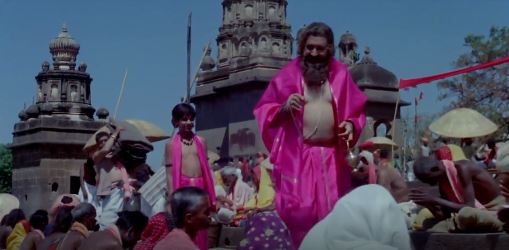
The story, based on Mahashweta Devi’s Laayli Aashmaaner Aaina, begins in Banaras of the 19th century (the riverfront, sadly, looks very mid-20th century). Bhawani Prasad (Jayant), bearded and seemingly benevolent, walks back from the temple after pooja. At his heels follows his grandson Kundan (?). Bhawani Prasad is much venerated, and the way he hands out alms to the poor and blesses those bowing before him, one might be forgiven for thinking him a good man.

Continue reading

The Clerk and the Coat (1955)

Aka Garam Coat, though The Clerk and the Coat is the title as it appears in the credits of this film, and is also the title for which the Censor Certificate was issued.

This film had been among my bookmarks for a long time, but I’d been putting off watching it because I had a suspicion it would turn out to be very depressing. And I’ve not been in a state of mind conducive to being able to watch depressing cinema. But after having watched several rather ho-hum films (Kismat ka Khel, Passport) I figured I should take the plunge and watch something good, even if not exactly frothy and cheery. Garam Coat, after all, was written by Rajinder Singh Bedi, for whom I have a great deal of respect.

The story is set in an unspecified North Indian town, where Girdhari (Balraj Sahni) lives with his wife Geeta (Nirupa Roy) and their three children: two girls and a pampered toddler named Chanda. Girdhari is a clerk at the post office, where he handles money orders. His two best friends are his colleagues Munilal ‘Muni’ (Rashid Khan) and Sher Khan (Jayant). Girdhari’s salary is so meagre that he and Geeta have to carefully monitor every paisa. This for the rent, this for the milkman, this for the kiraane ki dukaan from where they buy their groceries. This much for the insurance premium, for the electricity bill, for the girls’ school fees.

Continue reading

Dharti ke Laal (1946)

Balraj Sahni devotes several pages of his autobiography to one of his first films, KA Abbas’s directorial debut, Dharti ke Laal (1946). Here, among other behind-the-scenes reminiscences, is an anecdote which especially struck me.

A scene of the film depicts the death of one of its characters, an old peasant who has come to Calcutta to escape the famine in the countryside. In his dying delirium, the old man ‘sees’ the ready crop, fields of rice waiting to be harvested. Around him, his friends and family hover, as the man’s eyes open wide in joy and then, suddenly, he keels over.

It’s a dramatic scene, and was envisioned as taking place under a street lamp, with the light shining on the dying man’s face in his moment of delirium. The set was ready, but somebody had blundered, and the bulb that was supposed to shed its light on the character refused to light up. Abbas, Sahni, Shombhu Mitra (who played the role of the dying peasant), the cameraman and the rest of the crew were in a flap, when a mazdoor—a labourer—suggested an alternative: let the light be provided not by a street lamp, but by the headlights of an approaching car, shining on the dying man’s face. And, as the car moves away, its tail lights should provide the last glow before the man finally dies.

Continue reading

Hulchul (1951)

Today is the hundredth birthday of one of India’s greatest and most popular dancers of yesteryears. Sitara Devi was born in Calcutta on November 8, 1920, to a father who was a Sanskrit scholar and also both performed as well as taught Kathak. Her mother too came from a family with a long tradition in performing arts, so it was hardly a surprise that from a very young age, Sitara (her birth name was Dhanalakshmi) began to learn Kathak. By the time she was ten, Sitara was giving solo performances; two years later, at the age of twelve, she (having since moved to Bombay with her parents) performed onstage and so impressed film-maker/choreographer Niranjan Sharma that he recruited her to work in films.

Unlike several other skilled danseuses—Vyjyanthimala, the Travancore Sisters, Waheeda Rehman, etc—Sitara Devi did not let cinema take over her dance completely. She danced in a number of films, through the 40s and right up to Mother India (1957), which is believed to be her last onscreen appearance. She continued to give stage performances, even performing at New York’s Carnegie Hall and at the Royal Albert Hall in London.

Sitara Devi wasn’t merely a film actress; she was also a great dancer. I wanted to pay tribute to her through a review of one of her films, and decided I’d choose Hulchul, which I wanted to watch for other reasons as well (more on this later).

Continue reading

Satluj de Kande (1964)

One of my constant gripes is that it’s so difficult to get hold of good old regional Indian films with subtitles. For someone like me, fluent only in English and Hindustani and with no other regional language to fall back upon, the field is that much more restricted.

I few years ago, with much initial hesitation, I decided to take the plunge and watch a Punjabi film. Since my husband is Punjabi and several of his family members do converse in the language, I figured I’d learnt enough to be able to grasp what was happening. The rest, I thought, I’d ask my husband to translate.

Nanak Naam Jahaaz Hai, to my surprise, wasn’t hard to follow. Satluj de Kande (a film I was keen on watching because it had won the National Film Award), on the other hand, took some effort to follow.

More on that later. For now, what it’s about.

The story is set on the bank of the Satluj River, where the Bhakra Nangal Dam is being built. Ram Prakash Malhotra (Balraj Sahni) is a dam engineer and when the story opens, he’s irate. Ishwar Das (?), a contractor, has been proved to have been dishonest, and Malhotra is furious. Ishwar Das makes a big show of being very contrite, but Malhotra isn’t pacified.

Continue reading

Seema (1955)

Every now and then, I am reminded of a film which I’ve seen—often, many years ago—and which would be a good fit for this blog. Right time period, a cast I like, music I like. Some of these (like Pyaasa, Mughal-e-Azam or Kaagaz ke Phool) have been analyzed and reviewed so often and by so many stalwarts infinitely more knowledgeable than me that I feel a certain trepidation approaching them. Others are a little less in the ‘cult classic’ range, but good films nevertheless.

Like Seema. I remembered this film a few weeks back when I reviewed Naunihaal (also starring Balraj Sahni). At the end of that post, I’d inserted a very striking photo I’d found, of a young Balraj Sahni standing in front of a portrait of Pandit Nehru. Both on my blog and elsewhere on social media, some people remarked upon that photo: how young and handsome Balraj Sahni was looking in it. And I mentioned Seema, as an example of a film where Balraj Sahni appears as the hero. A hero of a different style than the type he played in Black Cat, but a hero nevertheless.

Continue reading

Naunihaal (1967)

Hindi cinema has its share of films in which children play an important part. And not just as the childhood version of the adult who plays the lead. Sometimes (Dhool ka Phool, Bandish) as unwanted. More often (Do Kaliyaan, Andaaz, Detective, Ek Hi Raasta, Laajwanti) as the means of bringing together two adults in a romantic relationship, or trying to hinder that relationship.

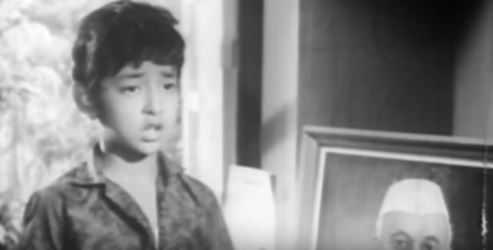
Less often, but I think often with more impact, children play the lead role: the film is about children, and the adults are mostly peripheral. Boot Polish and Diya aur Toofaan fall into this category. As does Naunihaal, about a little boy who sets off to meet Jawaharlal Nehru.

Continue reading