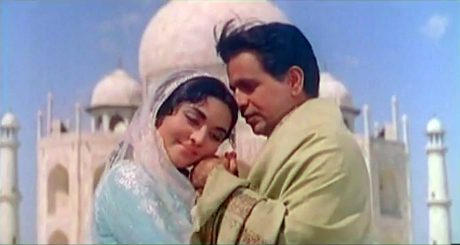
This blog post was inspired by an Instagram post by one of my favourite handles of all the social media channels I follow: Mad Mughal Memes, an absolutely delightful account that manages to combine informativeness with fun and often totally loony humour (my type, in case you don’t know that yet). Some time back, Mad Mughal Memes did a post in which they listed, with screenshots, some ten or so songs from Hindi films that were picturized at the Taj Mahal. Unlike me, of course, they weren’t constrained by a time period, so they had songs from very recently as well. Some songs (a very few) I was familiar with; others I had never heard of.
But it provoked a thought: why not a post on songs picturized at Mughal monuments? After all, it’s not just the Taj (though that, I agree, is the Mughal monument to beat all others). There are also forts, mosques—and gardens. Many of them very scenic, a perfect setting for a song.
Tag Archives: Hindi film music
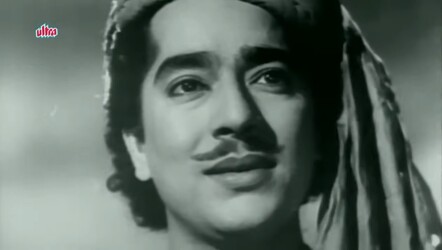
Ten of my favourite Pradeep Kumar songs
This post is ten days late. January 4, 2025 marked the 100th birth anniversary of an actor who, in an industry dominated by Punjabis, was one of just a handful of Bengali leading men. And, unlike—say, Biwasjit or Joy Mukherjee—to have a respectably long innings as an actor, playing lead roles right through the 50s and 60s, and then continuing as a character actor up to the last years of the 1900s. Impressive.
Continue readingNeither Here nor There: Rafi Sings for the In-Betweens
When, to celebrate the birth centenary (on December 24, 2024) of the one and only Mohammad Rafi, I compiled this list of my favourite Rafi songs for the top leading men of the 1950s and 60s, I was uncomfortably aware that I wasn’t doing justice to Rafi’s oeuvre. Even though I had tried my best to bung in mentions (and links) to many other songs Rafi had sung for these men. Because there were many other Rafi songs I could think of, which he had sung for actors absolutely opposite to these: extras, or actors who had woefully short-lived careers—in many cases men whose entire career might be said to hinge around one fantastic song that Rafi sang for them. A second Rafi list, arranged actor-wise, was therefore in order.
But in between the stars and the entities were a host of other actors who had the honour to lip-sync to Rafi’s voice. These were often character actors, or men who acted as villains. Even, in cases like Sanjay Khan, Premnath and Ajit, men who did appear in a fair number of films in leading roles, but cannot be said to have ever reached the heights of popularity or success of, say, a Dilip Kumar or Dev Anand, or even a Biswajit. They were the in betweens: not at all obscure, but not the Jubilee Kumar types.
Continue readingFamous songs, Not-so-Famous Faces: The Magic of Mohammad Rafi
Some days back, in celebration of the birth centenary of Mohammad Rafi, I posted a list of ten Rafi songs, picturized on ten different actors. Each of those men—Dilip Kumar, Dev Anand, Shammi Kapoor, even Johnny Walker—were immediately recognizable. Big names in their own ways (yes, even Johnny Walker, whom I personally think of as the greatest comedian to have lit up the Hindi silver screen). But even as I was compiling that list, I was thinking of all the many other times I’ve listened to a Rafi song, and have been unable to put a name to the man who’s lip-syncing to his voice.
Continue readingTen Men, One Voice: The Magic of Mohammad Rafi
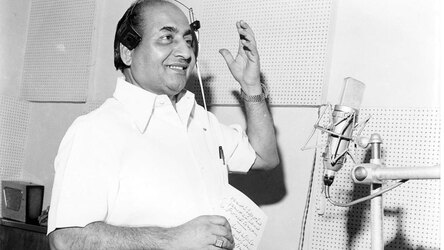
Today, December 24, 2024 marks an important birth centenary: that of one of the greatest singers ever to hail from the Indian subcontinent, the inimitable Mohammad Rafi. Born on December 24, 1924 in Kotla Sultan Singh (Punjab), Rafi would go on to dominate the world of Hindi playback singing in a way few of his contemporaries could, singing thousands of songs, winning awards by the dozen—and rarely (a rarity in itself, in a competitive industry) antagonizing those he worked with.
Continue readingChori Chori (1956)
Happy 100th birthday to one of India’s greatest film makers, Raj Kapoor!
RK was born in Peshawar on December 14th, 1924. What can I say about him that hasn’t already been said or written, and by people much more erudite, well-informed, and more fond of RK’s cinema than I am? Yes; I will admit that I am not the greatest of Raj Kapoor’s fans, but let us keep the whys and the wherefores of that, the debates and the discussions, for another time. As Anu Warrier (of Conversations over Chai, not just a fellow blogger I admire hugely, but also an RK fan) said “I know there are RK films you like!”: and for RK’s birth centenary, I decided it was high time I finally reviewed an RK film that I particularly like.
I have watched Chori Chori several times, and always with great satisfaction. Even though it starred Raj Kapoor (opposite Nargis, moreover), the film is not at all the sort of film RK was known for: this was the light-hearted romp that younger brother Shammi was to go on to make his own. A road trip, a pampered heiress, a romance. Lots of songs, great chemistry.
Continue readingTen of my Favourite ‘Multiple Version’ Songs: Duets
By which I mean two versions of the same duet.
This is part of an admittedly sporadic series of posts that focus on multiple versions of songs in old Hindi cinema. Composers and film directors have, again and again, homed in on songs that have staying power: songs that audiences wouldn’t mind listening to repeatedly in a film. Multiple version songs, as I’ve shown in previous posts of this type, take various forms. The type, for instance, where both a woman and a man sing the same song, but as solos. Or where a song is sung both as a duet and as a solo. Or, even, where the same singer (male or female) sings the same at two different points, but usually in two different moods.
And then there’s this: where a duet is repeated. Invariably, in two distinct moods. Given that the overwhelming number of duets in Hindi cinema tend to be romantic ones, there’s a certain predictability to the tones of these songs. One version is, more often than not, a happy version: two lovers celebrating their love and vowing eternal fidelity. The other version, just as often, is the complete opposite in tone. Things have fallen apart, fate (or disapproving parents, nasty relatives, lecherous villains, etc) have intervened and either sown the seed of suspicion, or used emotional blackmail to force one of the couple into giving up the other. There are also sorts of possibilities—and they lead, as below, to the old duet being again sung (often as an impossible duet, the estranged lovers physically too far apart to be really singing together).
Chaar Darvesh (1964)
YouTube suggested this film to me, and for a few days, I was torn. Should I watch it (Feroz Khan is not a favourite of mine, though I don’t find him as irritating as some others), or should I not? Sayeeda Khan, after all, is someone I’ve wanted to watch, mostly because I was intrigued—she was married to film director/producer Brij Sadanah, and was murdered by him on their son’s eleventh birthday party (Sadanah also shot and killed their daughter, before committing suicide). Yes, macabre (not to mention tragic), but that’s how it is.
Eventually, it was the music—by the very talented but vastly underrated GS Kohli—that tipped the scales in favour of my watching Chaar Darvesh. Kohli, who did a lot of work as assistant to OP Nayyar (and it shows, in the rhythms and styles of much of his work), composed music on his own for several B-grade films, of which among the best-known are Shikari (1963; easily his magnum opus, with one great song after another) and Chaar Darvesh. Even if just for the music, I wanted to watch this film.
The story is set in some fictitious fantasy kingdom somewhere in the Middle East. At a shrine, three bearded darveshes, clad in flowing robes, have gathered to pray for boons. One is seeking a treasure [that sounds a little shallow, for a darvesh]; another is searching for his sweetheart, who’s gone missing.
These three men have learnt, though, that their wishes will only be granted once they have been joined by a fourth darvesh… who, thank heavens, arrives soon after. This is Qamar (Feroz Khan in blackface), and he proceeds to tell them his tale of woe and to explain how he happens to have turned so black.
Continue readingTen of my favourite ‘multiple version’ songs: solo/duet (or more)
Many years back, I’d begun doing a series of posts on multiple version songs in old Hindi cinema. Songs that seem to have struck their composers/film directors as so impactful that they needed to be repeated, in different scenarios, sometimes in different moods and even with different singers, singing differing lyrics. I did two of those posts, then something cropped up (I don’t remember what) and the project got abandoned.
But I’ve got back to this now, and here’s a third post on multiple version songs. My earlier posts focused on solos: two-version songs sung by a male singer and a female singer; and the same song, sung by the same singer but in two versions.
This time, I’m focusing on songs that appear at least twice in a film, but at least once in the form of a solo and the other time as a duet (or more: one of the songs in this list has three singers).
Continue readingTen of my Favourite Bathroom Singers
If ‘bathroom singer’ refers to ‘a mediocre or amateur singer’, then Hindi cinema belies that definition: because old Hindi films have plenty of instances of songs sung by people in bathrooms, while bathing, shaving, washing up, whatever—and all perfectly in tune. These bathroom singers are no bathroom singers at all.
If you don’t know what I’m talking about, here’s my list: ten songs that illustrate the point. Barring one song, all are from pre-1970s Hindi films that I’ve seen; the exception is a song from the cusp (1972), but I’ve included it because the film in question (Dil Daulat Duniya) always strikes me more—in tone, look, fashions, actors, etc—as a late 60s one.
The only other criterion I’ve kept in mind is that at least one verse is sung inside the bathroom.
Continue reading