Jaal (1967)

I had first watched this film many, many years ago, probably as a young teen. It had been aired on Doordarshan, back in the good old days when our family used to watch pretty much every film that was shown (including some seriously grotty ones like Fauji).

I remembered little of Jaal: Mala Sinha and Biswajeet, yes; and that it was a suspense thriller set in a spooky mansion beside the sea. That was all.

While I don’t like Biswajeet, and the music of Jaal (by Laxmikant-Pyarelal) is forgettable enough to not want to watch it for the songs, I decided I should give this one another try. At least find out what it’s about.

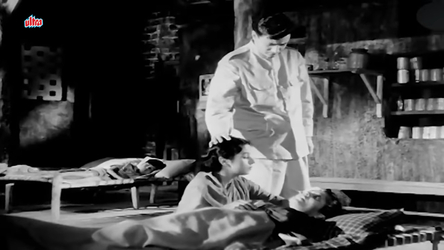
The story begins on a stormy night at sea. A small boat is tossed about on the waves, and we catch glimpses of the lone man on board: Sunder Singh (Sujit Kumar) as he tries to control his vessel. In the distance can be seen (like the boat and the waves, looking patently artificial) a lighthouse. Sunder, however, cannot make it safely to shore; his boat crashes against the rocks and explodes in a great burst of fire.
Continue reading

Kaala Bazaar (1960)

The first time I watched Kaala Bazaar was perhaps in my early teens: the film was being shown on Doordarshan, and given that back then I was very fond of Dev Anand, I watched it. I have very vague recollections of that viewing. What I do recall, vividly, is that I didn’t like that my hero was a criminal.

… which, as I came to realize later, was actually not so very uncommon a style for the characters Dev Anand played. Unlike the other major romantic hero of the time, Shammi Kapoor, Dev Anand didn’t just play characters who got up to ‘mischief’, so to say; his characters—from Tony in Jaal to Raju in Guide, from Chhagan in Roop ki Rani Choron ka Raja to Babu in Bambai ka Babu, plus others—were outright criminals: thieves, conmen, smugglers, men definitely on the wrong side of the law.

Like Raghubir ‘Raghu’ in Kaala Bazaar. Raghu is a bus conductor when the story begins, and within the space of a couple of minutes, his life takes an about-turn. A belligerent passenger is standing in the bus (which is against the rules), and when Raghu asks him to get off the bus, the man refuses. Both he and Raghu lose their tempers. Fists fly, and the next thing we know, Raghu is without a job.

Raghu’s mother (Leela Chitnis) is ill, and he has a sister (Nanda) and a young brother (?) as well; he cannot afford to be without a job. Desperate, Raghu flounders about, trying to find work. If not work, money.

Continue reading

Kangan (1959)

In which Iftekhar, playing against type, acts the part of a lecherous villain. And Chitragupta, composing against type, proves he was no one-trick pony.

But, to begin at the beginning (and Kangan gets into action right at the start, not dilly-dallying about with incidental stuff). Karuna (Nirupa Roy) is about to get married, and her widowed father (?) is giving her his blessings and wishing her mother were still around. Just then, Kamla (Purnima) comes in; she is not just Karuna’s bridegroom’s sister, but also a good friend of Karuna’s. Karuna’s father leaves the two women together and goes off.

Continue reading

Sunghursh (1968)

This was the first film I watched after Dilip Kumar passed away on July 7 this year. The tributes and reminiscences were still in full flow two days later, on July 9, which marked what would have been the 83rd birthday of Sanjeev Kumar. On a Sanjeev Kumar tribute post on Facebook, I read a comment in which someone recalled Dilip Kumar’s remark about Sanjeev Kumar, who was his co-star in Sunghursh: “Is Gujarati ladke ne toh paseena nikaal diya!” (“This Gujarati boy made me sweat!”)

This, I thought, might be an interesting film to review by way of tribute to both Dilip Kumar as well as Sanjeev Kumar. But I had other Dilip Kumar films to also watch: Musafir and Sagina Mahato for the first time, Ram aur Shyam for a long-overdue rewatch. So, while I watched this and wrote the review, I decided the publishing of the review could wait for now.

Because today, August 21, 2021, marks the birth centenary of Harnam Singh Rawail, the director of Sunghursh.  HS Rawail, as he was usually billed, debuted in 1940 with the film Dorangia Daaku, but it wasn’t until 1949, with Patanga (of Mere piya gaye Rangoon fame) that he became famous. Rawail was to make several well-known films through the following decades, but his two best-known works are probably Mere Mehboob (1963) and Sunghursh.

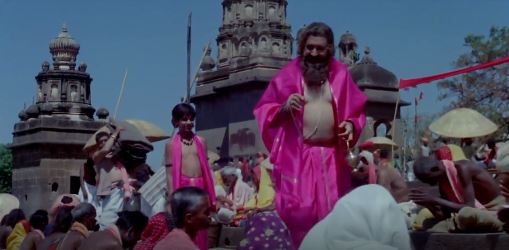
The story, based on Mahashweta Devi’s Laayli Aashmaaner Aaina, begins in Banaras of the 19th century (the riverfront, sadly, looks very mid-20th century). Bhawani Prasad (Jayant), bearded and seemingly benevolent, walks back from the temple after pooja. At his heels follows his grandson Kundan (?). Bhawani Prasad is much venerated, and the way he hands out alms to the poor and blesses those bowing before him, one might be forgiven for thinking him a good man.

Continue reading

Funtoosh (1956)

Today may (or may not) be the birth centenary of the film maker, writer, and actor Chetan Anand, eldest brother of Dev Anand and Vijay Anand. Different sources list different dates of birth: most sites (including IMDB) list his birth date as January 3, 1921; others, including Wikipedia (yes, I know not the most reliable of sources) say it’s January 3, 1915. (This article says it’s 1921, but then goes on to write that Chetan Anand was 27 years old in 1943, which is either dodgy maths or a suggestion that the year of birth was indeed 1915). The article, barring that slip, is a good, interesting introduction to the life and career of Chetan Anand.

Anyway. Even if I’m six years too late to the party, at least today is Chetan Anand’s birthday.

Continue reading

Roop ki Rani Choron ka Raja (1961)

In 1956, Waheeda Rehman made her debut in Hindi cinema in CID, with Dev Anand (Waheeda wasn’t the heroine of CID—Shakila was—but she had a good and somewhat offbeat role as the vamp with a heart of gold). Over the next decade and a half or so, Waheeda and Dev Anand were to go on to act together in several more films, probably their most famous pairing being in the hugely popular Guide (1965).

I have watched, as far as I know, all of the Waheeda-Dev films over the years. The only one that (again, as far as I know) I hadn’t watched yet was this one. Time, I decided, to make amends for that.

As in many other films of his, Dev Anand in Roop ki Rani Choron ka Raja is a crook—a thief, to be precise. We are introduced to Chhagan (Dev) when he’s in a shady-looking dive, buying a bottle of booze. Shortly after, Chhagan is accosted by ‘Langad Deen’, a partly-crippled character (played by Jeevan), who has a bit of news for Chhagan: a steamer is about to begin the journey down the river to the pilgrimage spot of Shivsagar. Langad Deen has it on authority that among the people on board is a wealthy jeweller who is carrying a very valuable diamond to be offered up to the god Shiv at Shivsagar.

Continue reading

Nanak Naam Jahaaz Hai (1969)

Early in 2013, to mark hundred years of Indian cinema, I dedicated an entire month to regional Indian cinema. I reviewed several films of different languages, and realized, in the process, just how difficult it is to get hold of old regional films that have subtitles. Even when they’re blockbuster hits, National Award-winning films, films that must have been subtitled at some stage to enable a jury to judge them worthy of a prestigious award.

Among the films that I came across, but which wasn’t subbed, was this extremely popular Punjabi film, which won the National Award for Best Feature Film in Punjabi, as well as the National Film Award for Best Music Direction. My husband’s a Punjabi but speaks the language very rarely, and that too when he has no other option (as a result, his Punjabi is pretty shaky). As for me, the less said about my Punjabi, the better. But I had this film bookmarked from 2013, and when I discovered last year that Nanak Naam Jahaaz Hai had been digitally restored and re-released, I thought I may as well take the plunge.

Prithivraj Kapoor as Gurmukh Singh in Nanak Naam Jahaaz Hai

Continue reading

Baazi (1968)

The first time I began watching this film was on Doordarshan, many years ago. It surprised me, largely because it featured Waheeda Rehman in a very Westernised avatar I had never seen before. It also had an intriguing story. And Dharmendra, always one of my favourites. And Helen. And Johnny Walker.

Waheeda Rehman in Baazi Continue reading

Johny Mera Naam (1970)

One day in August, I checked my blog roll and discovered that not one, but two, of my favourite bloggers had posted reviews of films based (even if only in spirit) on The Arabian Nights. Anu had reviewed Ali Baba aur 40 Chor, and Ira (aka Bollyviewer) had reviewed The Thief of Baghdad. Coincidence? Planned? If the latter, then why hadn’t I, the third of the three soul sisters, been included in the plan?
It turned out to have been sheer coincidence, but Anu, Ira and I decided it would be a good idea to actually do a themed set of posts. And what better theme than the one Ira suggested: long-lost siblings, such a favourite trope in Hindi cinema.

So here goes. Head over to Anu’s blog to read her review of the delightful Yaadon ki Baaraat (singularly appropriate, considering the link between Anu and me) and to Ira’s blog to read her take on another extremely popular (and superb!) lost-and-found-siblings film, Seeta aur Geeta. And here, of course, is mine: a review of a film which just manages to make the cut for my blog when it comes to time period. A classic story of long-separated brothers who grow up, unknown to each other, on opposite sides of the law.

Dev Anand and Pran in Johny Mera Naam Continue reading

Waqt (1965)

By some strange oversight, despite the fact that Waqt is one of my favourite masala films, I’ve never reviewed it on this blog. And I’m wishing I didn’t have to end up writing about it on such a sad occasion—because Achla Sachdev, the actress who played the self-sacrificing, long-suffering mother and wife in this film, passed away on April 30, 2012.

Continue reading