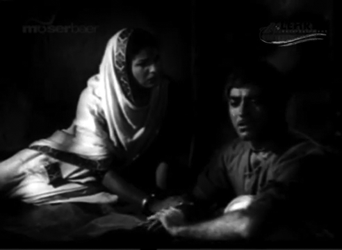
Phool aur Patthar (1966)

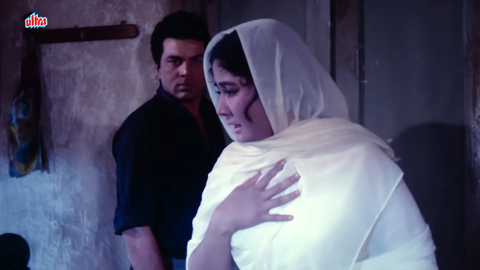
A couple of years back, I watched (and later reviewed) the Meena Kumari-Dharmendra starrer, Bahaaron ki Manzil. A good suspense thriller, it put me in mind of another film starring these two: Phool aur Patthar. I had seen the film many years ago, as a child (implication: this would have been in the early 80s, when Doordarshan’s sole TV channel was our only entertainment besides books and radio, which meant we watched anything that was aired, no matter how mediocre). I remembered nothing of it except that Dharmendra played a thief who ends up being cared for by Meena Kumari, playing a widow.

Continue reading

Howrah Bridge (1958)

Aaiye meherbaan baithiye jaan-e-jaan, and Mera naam Chin Chin Choo. Two great actresses, two iconic songs.

When I was doing the Helen tributes last month, I was reminded of Mera naam Chin Chin Choo all over again—and remembered, too, that I had never reviewed Howrah Bridge on this blog. It has also been many years since I last watched the film (before I launched Dusted Off), so I decided it was high time I revisited this.

Howrah Bridge begins very far from the bridge, and in fact from Kolkata: in Rangoon, where Prem Kumar (Ashok Kumar) finds his father (Brahm Bhardwaj) in a flap. Daddy is distraught because Prem’s elder brother Madan (Chaman Puri, in a cameo role) has run off from home, taking with him an invaluable family heirloom, a dragon which has been in the family for generations. We later discover that the dragon was crafted in China many centuries ago, and from there came to be owned by the king of Burma, after which it passed into the possession of Prem’s family.

Continue reading

Kaala Bazaar (1960)

The first time I watched Kaala Bazaar was perhaps in my early teens: the film was being shown on Doordarshan, and given that back then I was very fond of Dev Anand, I watched it. I have very vague recollections of that viewing. What I do recall, vividly, is that I didn’t like that my hero was a criminal.

… which, as I came to realize later, was actually not so very uncommon a style for the characters Dev Anand played. Unlike the other major romantic hero of the time, Shammi Kapoor, Dev Anand didn’t just play characters who got up to ‘mischief’, so to say; his characters—from Tony in Jaal to Raju in Guide, from Chhagan in Roop ki Rani Choron ka Raja to Babu in Bambai ka Babu, plus others—were outright criminals: thieves, conmen, smugglers, men definitely on the wrong side of the law.

Like Raghubir ‘Raghu’ in Kaala Bazaar. Raghu is a bus conductor when the story begins, and within the space of a couple of minutes, his life takes an about-turn. A belligerent passenger is standing in the bus (which is against the rules), and when Raghu asks him to get off the bus, the man refuses. Both he and Raghu lose their tempers. Fists fly, and the next thing we know, Raghu is without a job.

Raghu’s mother (Leela Chitnis) is ill, and he has a sister (Nanda) and a young brother (?) as well; he cannot afford to be without a job. Desperate, Raghu flounders about, trying to find work. If not work, money.

Continue reading

Talaash (1969)

There are a bunch of films that I’ve read a plot synopsis of, found it interesting, thought I’d try and watch it—and then taken a look at the cast, only to discover it starred someone I didn’t like. It’s happened time and again; with Talaash, having discovered that the film starred Rajendra Kumar, I decided to put the film on the back burner, even though the synopsis sounded interesting.

Then, reading Anirudha Bhattacharjee and Balaji Vittal’s SD Burman: The Prince Musician, and seeing the list of songs (some of them truly lovely ones), I thought I may be able to sit through the film. Perhaps the rest of the cast, the interesting story, and the good music, would compensate for Rajendra Kumar.

Talaash begins with the graduation of Raj Kumar ‘Raju’ (Rajendra Kumar), who is being congratulated by all his classmates for having once again come first in the class. Raju goes off to meet his friend Lachhu (OP Ralhan, who also directed this film, which was produced by Rajendra Kumar). Lachhu has, after seven tries, finally managed to graduate too. They congratulate each other, and talk briefly of their futures. Lachhu will be roped in to work at his wealthy father’s cloth shop; Raju doesn’t know what he’ll do, but he’s certain: the wealth of his family will only be doubled. Yes, he’s not known want, ever, and he will continue to enjoy all that wealth, now through his own hard work.

Continue reading

Vachan (1955)

I started my first draft of this post by writing that “I watch some films because of the people who made them”. Then it struck me that that, almost invariably, is the only reason I do watch a film. After all, everybody—the director, the music director, the lyricist, and of course the cast (besides the many hundreds of other, often unnamed, people) who work on a film are those who made them. Sometimes, it’s the cast that appeals to me: give me people like Shammi Kapoor, Dev Anand, Sadhana, Waheeda Rehman—oh, and many more—and I will happily begin watching any film they’re in (whether or not that experience will end up being as rewarding a one I’d hoped for is another matter). Sometimes, it’s just the name of a well-loved and much-respected director—Bimal Roy, Hrishikesh Mukherjee, Vijay Anand among them—that’s enough.

Sometimes, it’s the music. Sometimes, it’s just one song.

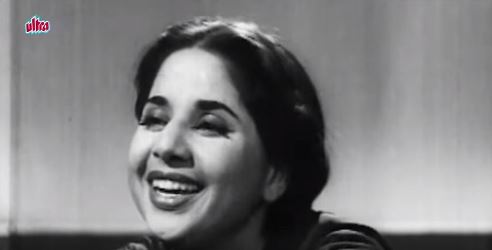
In this case, it was just one song. I was singing Chanda mama door ke to the LO the other day, and I thought: that’s a nice song, and Geeta Bali looks so pretty; I wonder what the film’s like.

Continue reading

Mohabbat Isko Kehte Hain (1965)

A little less than a week ago, on December 4, I received news that a very dear aunt had passed away. My parents, my sister and I made arrangements to travel to Kolkata for the funeral, the next day. Early in the morning, just as I was about to leave for the airport, the newspaper was delivered, and one headline sprang out at me: Shashi Kapoor had passed away, too. On the very same day as my aunt.

I suppose if Shashi Kapoor had passed away on any other day, on a day when I was not quite so swamped in sorrow of my own, I would have posted a tribute to him earlier. Later, I thought. When I am a little less distraught. My father, reading the newspaper, remarked that he and Shashi Kapoor had been born in the same year, just 6 months apart (my father in September 1938, Shashi in March 1938). My mother, looking at a lovely photo of a smiling and very handsome young Shashi, remarked that he looked uncannily like a cousin of mine (which I have to agree with; I have thought so many times). In our own ways, all of us remembered Shashi Kapoor.

Continue reading

Humsaaya (1968)

In which Joy Mukherji single-handedly (with some help from the snow-clad Himalayas) defeats an invading army of Chinese guerrillas, thus lending a whole new meaning to the phrase ‘humsaaya aasmaan ka’.

Continue reading

Bahaaron ke Sapne (1967)

I can blame my not having watched Bahaaron ke Sapne all these years on my father: when I first expressed an interest in the film because it had been directed by Nasir Husain (back then, a teenaged me associated Nasir Husain only with frothy and entertaining films like Dil Deke Dekho, Tumsa Nahin Dekha, and Phir Wohi Dil Laaya Hoon), my father said, ‘It’s a serious film.’

And that was that. Because, back then, I didn’t care to ask how serious. Anything that smacked of reality rather than escapism was not to be touched with a barge pole.

Rajesh Khanna in Bahaaron ke Sapne

Continue reading

Aankhen (1968)

I spent part of last week reading fellow blogger Todd Stadtman’s book, Funky Bollywood: The Wild World of 1970s Indian Action Cinema (more on that, along with a link to my review of it, at the end of this post). Todd’s book discusses, in affectionate detail, all the iconic action films—spy thrillers included—of the 70s. In a fit of enthusiasm, brought on by Todd’s book, I told my husband, “I want to see Gunmaster G-9”. To which he replied, “I didn’t like that. What I really liked was Aankhen. That was fun.”

Dharmendra in Aankhen Continue reading

Godaan (1963)

I am not a one to make New Year’s resolutions; more often than not, it’s just something I silently tell myself I should attempt to do over the course of the coming year. At the start of 2014, I decided I should read more classic fiction this year—and, importantly, more fiction that wasn’t originally in English. Since the only two languages I am fluent in are English and Hindi, it meant that the only untranslated works I could read would be in either of those two languages. So, after many years (if I remember correctly, I last read a Munshi Premchand novel in school), I decided to read his landmark novel, Godaan.

…and didn’t even know, till a couple of months back, that it had been adapted into a film. When I discovered Godaan on Youtube, I bookmarked it immediately (noting, though, with trepidation, that it starred two people I’m not especially fond of: Raj Kumar and Kamini Kaushal). And I vowed to watch it as soon as possible, at least while the novel was still fresh in my mind.

Raj Kumar and Kamini Kaushal in Godaan Continue reading