
Looking through the blog posts I’ve published over the past few months, I realized what a long time it’s been since I reviewed one of those Hollywood classics, the type of film that people tend to recognize the name of, even if they’ve never seen it, or even if the film didn’t win any awards. Or wasn’t, eventually, as in this case, all that great after all. But I wanted to watch The Last Time I Saw Paris for two reasons: one, it stars Elizabeth Taylor, one of the most mesmerizing faces in 50s’ Hollywood.
Category Archives: Dusted Off

Ten of my favourite string instrument songs
After I’d done my piano song posts, I began to think of other musical instruments that appear in the picturisation of songs. Songs where it’s not an orchestra (Ted Lyons and His Cubs, anyone? Or The Monkees?), but a hero or heroine, not a professional musician, being the one ‘playing’ an instrument? Guitars, I thought, would be a good place to start. A ‘guitar songs’ post. I tried by listing, off the cuff, all the songs I could remember as having a guitar-playing actor or actress. Then I went and checked on Youtube—and discovered that several of the songs I’d remembered as featuring a guitar actually featured a different string instrument: a mandolin, for example (in Tum bin jaaoon kahaan), or some even more unusual and exotic instruments.
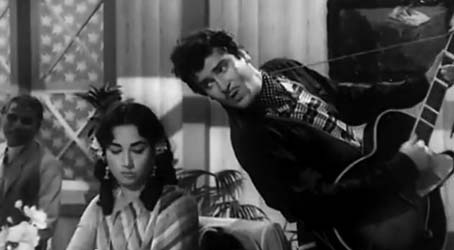
Rustom Sohrab (1963)
Who would’ve thought that the Ramsay Brothers’ first production was a historical worthy of a Sohrab Modi [granted, it does have two far-too-chubby leading men and its fair share of violence, but still; Rustom Sohrab is no horror film, not by a long shot]? But yes, Ramsay Productions—famous for its B grade horror films of the 80s and 90s—did make this rather surprising debut, a film based on the Persian epic poem Rostam and Sohrab (part of the famous Shahnameh).

Flower Drum Song (1961)
A very belated tribute to an actor I’ve actually seen only in a couple of films, but whom I like a lot: James Shigeta. The Hawaiian-born Shigeta passed away on July 28 this year, and it came to me as a shock a couple of days ago when I discovered that he was gone—and that no newspaper and none of the sites I occasionally visit—mentioned it. The news, however, made me remember the first film in which I saw James Shigeta: Flower Drum Song, one of his earliest films. Very different from his debut film (the superb The Crimson Kimono, one of my favourite noirs), but enjoyable in its own way—and an interesting commentary, both deliberate and unwitting, on immigrants in the US.

Johny Mera Naam (1970)
One day in August, I checked my blog roll and discovered that not one, but two, of my favourite bloggers had posted reviews of films based (even if only in spirit) on The Arabian Nights. Anu had reviewed Ali Baba aur 40 Chor, and Ira (aka Bollyviewer) had reviewed The Thief of Baghdad. Coincidence? Planned? If the latter, then why hadn’t I, the third of the three soul sisters, been included in the plan?
It turned out to have been sheer coincidence, but Anu, Ira and I decided it would be a good idea to actually do a themed set of posts. And what better theme than the one Ira suggested: long-lost siblings, such a favourite trope in Hindi cinema.
So here goes. Head over to Anu’s blog to read her review of the delightful Yaadon ki Baaraat (singularly appropriate, considering the link between Anu and me) and to Ira’s blog to read her take on another extremely popular (and superb!) lost-and-found-siblings film, Seeta aur Geeta. And here, of course, is mine: a review of a film which just manages to make the cut for my blog when it comes to time period. A classic story of long-separated brothers who grow up, unknown to each other, on opposite sides of the law.
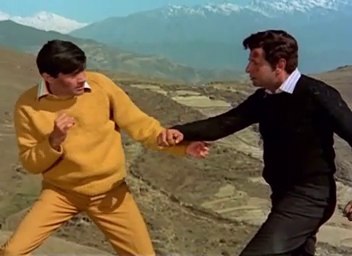
Bahu Begum (1967)
…which could probably have been more appropriately titled How to Jump to Conclusions and Mess up Lives. Or Never Trust a Sinister Mamu. This is one Muslim social – a genre I have long admitted to being very fond of – which has been recommended to me so often, I’ve lost track of the recommendations. On the one hand, I wanted to see it because it has some lovely songs; on the other, the thought of watching Meena Kumari in one of her last few films – well, that wasn’t something I was really looking forward to with anticipation. But all those recommendations tilted the balance.

Ten of my favourite ‘male pianist’ songs
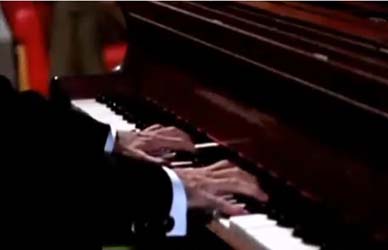
Some time back, I received a request from a blog reader and long-ago professor of mine: would I do a post on songs sung at pianos? Hindi cinema, back in the good old days, invariably had a song at a piano per film, often more. I had to inform my ex-prof: I had already compiled, some time back, a post on piano songs: specifically, women pianists. But this gave me an idea: how about a post on male pianists? After all, there has been no shortage of songs picturised on men sitting at pianos.
Rear Window (1954)
Friend, blog reader and sometime fellow blogger Harvey nudged me gently last week with a bit of information I hadn’t remembered. August 13th, 2014 was the 115th birth anniversary of Alfred Hitchcock. Was I planning to post something Hitchcock-related to mark the occasion?
And how could I not? Hitchcock – in my opinion, one of the best directors cinema has ever seen, regardless of time and place – is a firm favourite of mine. I’ve reviewed several of his films; in fact, one of the first films I reviewed on this blog (The 39 Steps) dates from Hitchcock’s early British period. I’ve reviewed a hilariously black comedy (The Trouble with Harry); I’ve reviewed classics like Rebecca, and relatively little-known ones (among those not Hitchcock aficionados, I hasten to add) like Strangers on a Train or Lifeboat.
Time (and occasion) therefore, I concluded, to review one of my favourite of Hitchcock’s colour films, in the classic suspense mould. Rear Window, about a photographer stuck in his tiny apartment with a broken leg…

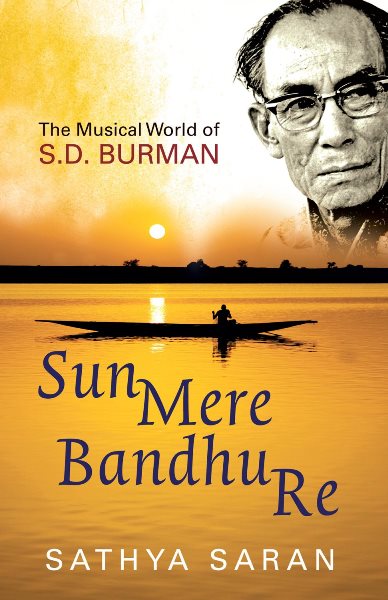
Book Review: Sathya Saran’s ‘Sun Mere Bandhu Re: The Musical World of SD Burman’
To say that I am fond of Sachin Dev Burman is to put it mildly. Along with OP Nayyar, SD Burman was one of the first music directors I heard of—thanks to my father, who is a devoted fan of the music of these two very different composers. It was my father who, when I was still a pre-teen, first drew my attention to the beauty of Thandi hawaayein lehraake aayein, Hum bekhudi mein tumko pukaare chale gaye, O re maajhi, Dekhi zamaane ki yaari, Yeh mahalon yeh takhton yeh taajon ki duniya, and dozens of other songs, each more wonderful than the last.
That love for SD Burman has, instead of abating, increased over the years. With that love has arisen a deep admiration for the sheer versatility and genius of this man, without whom the face (or should that be ‘sound’?) of Hindi film music might have been very different. And much, much the poorer.
Not a surprise, then, that I should get so excited when I discovered that a biography of SD Burman had been published: Sathya Saran’s Sun Mere Bandhu Re: The Musical Journey of SD Burman (Harper Collins Publishers India, P-ISBN: 978-93-5029-849-7, E-ISBN: 978-93-5029-850-3, Rs 499, 258 pages). I had read about and heard various anecdotes about SD Burman over the years: that he was a prince of Tripura, of his love for paan and football, and how he skilfully drew inspiration from just about every type of music: Baul, Bhatiali, Rabindra Sangeet… to actually read a biography of the man himself was something I looked forward to with great anticipation.
Mamta (1966)
While watching Pakeezah some months back (and reading Meghnad Desai’s book about the film), I was struck by how fond old Hindi cinema used to be of the motif of the ‘chaste tawaif’. A paradox, seemingly, because how could a woman be a tawaif – a prostitute, to put it bluntly – and be chaste? But films like Pakeezah and Adalat did just that: they portrayed women who lived in kothas, sang (in Adalat) and danced (in Pakeezah) but were ‘good’ women, chaste and pure, women who may have been lusted after by bad men, but who – thanks to fate, good friends and relatives, kind strangers (both human and animal) – were always able to avoid the fate worse than death: of yielding their chastity to a man they were not married to, or weren’t going to eventually marry, even if only in secret.

 Dustedoff