Ten of my favourite Hemant songs – as a composer

There is already a ‘Ten of my favourite Hemant songs’ list on this blog, compiled in the very early days of my blogging. Those songs were of Hemant singing; songs like Tum pukaar lo, where the haunting beauty of Hemant’s voice immortalized a song for me.

This list, to differentiate it from that one, is of songs composed by Hemant—since Hemant, besides possessing a beautiful voice, was also a very talented composer. And today being the birth centenary of Hemant, it would be unforgivable for me to not post a tribute to one of my favourites from Hindi film music.

Continue reading

Ten of my favourite Bharat Bhushan songs

Over the years this blog has been in existence, several people have asked me to compile a list of songs that are beautiful to listen to, but which are terribly picturized—songs which I don’t like to watch, only listen to. Every time I’ve started to compile a list, I’ve given up quickly, because I’ve found myself listing almost all of Bharat Bhushan’s songs.

Bharat Bhushan, while he lip-synced to some truly memorable songs, has never been one of my favourite actors. But one thing is undeniable: this man was at one time hugely successful, working opposite some of Hindi cinema’s leading ladies—from Madhubala to Meena Kumari, Nimmi to Mala Sinha—and commanding among the highest fees of his time. Bharat Bhushan, in his heyday, was not to be scoffed at (it’s a different—and very sad—story that he went from rags to riches, being reduced to acting as an extra, and being spotted by Amitabh Bachchan waiting in line at a bus stop).

Continue reading

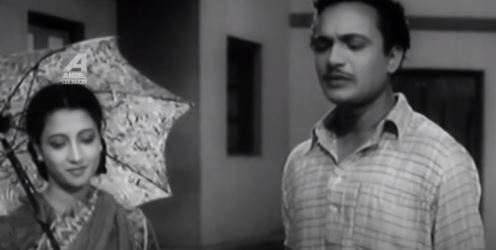
Shaarey Chuattar (1953)

Bengali cinema is one of the few regional language cinema industries for which it’s relatively easy to find subtitled copies. Even when the film in question is an old one.

Over the years, several Bengali readers have recommended Shaarey Chuattar to me. I had been under the impression that I should watch this film for the Uttam Kumar-Suchitra Sen pairing (it was the their first film together, the first of many films in which they were co-stars). But, now that I’ve seen it, I can safely say that this is a film you should watch not for these two, but for the film itself. True, Suchitra Sen and Uttam Kumar provide some eye candy and are a likable romantic couple, but the romance in Shaarey Chuattar is not the main thing.

Continue reading

Saqi (1952)

I still remember my first glimpse of Premnath in a different persona than the fat, balding, beetle-browed villain of so many ‘70s films.

This was in the mid-80s. My sister and I (I was then not even in my teens) were watching Chitrahaar, and Thandi hawaayein lehraake aayein came on. It was proceeding fine, with Nalini Jaywant flitting across the screen, when suddenly a strikingly handsome man, tall and broad-shouldered, sprang up by her side, danced with her, and then disappeared. Who was that? We asked each other, and couldn’t supply an answer. We turned to our father, our source of information for all things old Hindi cinema. Papa said that Naujawan starred Premnath. Who Premnath, we asked in disbelief. That paunchy and somewhat repellant man in Johnny Mera Naam?

It took a watching (incomplete, sadly, because the electricity went) of the 1951 film Sagaai to convince us that yes, Premnath was indeed quite a hottie in his heyday.

If you think so too (or if you haven’t seen Premnath in the early 50s, when he was paid more than Raj Kapoor and several other leading actors), you should watch Saqi.

Continue reading

Ten of my favourite ‘multiple version songs: one voice, two solo versions

After last week’s post of multiple version songs featuring one male voice and one female voice singing the same song, I decided I should do another post of ‘multiple version’ songs. Also solos, and also (as in the previous post), songs which appear within the same film.

Usually, when one singer (invariably singing for one character) ends up singing two versions of the same song, it’s because the story has changed circumstances for the character. It could be—in most cases—that happy days have given way to sad; or ennui has made room for a sense of purpose. In some (relatively rare) cases, the same singer sings two different versions of the same song for two different characters.

Continue reading

Ten of my favourite ‘multiple version’ songs – male/female solo versions

There are times I’ve watched a film (like Daag, or Pyaar ka Mausam, or Taqdeer) and got the distinct feeling that the music director composed one especially good tune in the film, and that was a fact acknowledged by the film maker too, who decided to use that tune in different versions throughout the film. Therefore we have Ae mere dil kahin aur chal in several versions, and the same with Tum bin jaaoon kahaan or Jab-jab bahaar aayi aur phool muskuraaye. The tune, at least in essence is the same (the tempo may change); the singer(s) may be different, the actors who lip-sync to it may be different, and there may be other differences as well.

‘Multiple version’ songs can be of different types. The most common (from what I can tell; I haven’t researched this) is the differentiation of tone: the happy version/sad version scenario. One version of the song (usually the one that appears earlier in the film) is an upbeat, happy one; the other uses the same tune, but often different lyrics that reflect two different situations.

Then there are songs where different versions may be only sung by different playback singers—which might include (as in the case of Jab-jab bahaar aayi) one version sung as a solo, another as a duet or even by a trio. There are also versions (overlapping with regional language cinema) where the same tune is used in songs in films of different languages, for instance the Bengali song Ei raat tomaar aamaar (from Deep Jwele Jaai) appears as the lovely Yeh nayan dare-dare in the Hindi film Kohraa.

Those are versions for other, later song lists. For this post, I’m going to confine myself to one particular type of ‘multiple version’ song: the solo male singer/female singer song.

Continue reading

Chanda aur Bijli (1969)

Chanda aur Bijli is one of those films I’ve known about for a long time—because of a family anecdote that is centred around a song from this film. My sister, a toddler when Chanda aur Bijli was released, quickly fell in love with Bijli hoon main toh bijli. Her version of it, though, was somewhat different (and suggests a mind that dwelt rather heavily on food):

Bijli hoon main toh bijli
Bun khaake jab bhi nikli
Logon ke dil mein machhli
(And here she’d add a little line completely off her own bat: ‘Wohi machhli jo Baby ne khaayi thhi!’)

For those who don’t understand Hindi, that means:

Lightning; I am lightning,
When I went out after eating a bun,
There was a fish in people’s hearts
That same fish that Baby ate!

The original, of course, is a rather more predictable Hindi film song:

Bijli hoon main toh bijli
Bal khaake jab bhi nikli
Logon ke dil mein machli

(Lightning; I am lightning,
Every time I went out, tripping along,
I made people’s hearts trip)

Continue reading

Raat ke Raahi (1959)

What a dreadful year this is turning out to be. As if the communal violence at the start of the year wasn’t bad enough, we were then hit by coronavirus. And as I struggle to cope, trying to keep my spirits high in the face of failing economies, loss of income, and of course the threat of a lethal disease—the last thing I needed was the passing of two of my favourite actors. Irrfan Khan and Rishi Kapoor, both very good actors, immensely watchable and with a charisma hard to match, died within 24 hours of each other.

This blog is not about cinema after 1970, so there will not be a separate tribute piece for these two brilliant actors, but yes: I did want to put it out there, my sorrow at their passing, a blow that oddly enough (given that I never even met either of them) hit really hard.

What this is, though, is a tribute to another actor, someone whose birth centenary it is today. Achla Sachdev.

Continue reading

Dragonwyck (1946)

A poor and impressionable young woman arrives at a grand mansion and is blown away by its magnificence—and by the attractive man who is master of the manor. Except that the manor (and the man himself) may have secrets to hide…

Dragonwyck begins at the Wells farm in Connecticut. The Wells are stolid peasant stock: hard-working, sensible, god-fearing. One of their two daughters, Miranda (Gene Tierney) is somewhat less stolid than her parents—especially her father Ephraim (Walter Huston)—would like her to be. At the start of the film, Miranda comes racing into the farmhouse, bearing a letter for her mother Abigail (Anne Revere). The fine envelope and the grand address from which it’s come—Dragonwyck—are enough to convince Miranda that this is a letter of some worth.

Continue reading

Book Review: Jerry Pinto’s ‘Helen: The Life and Times of a Bollywood H-Bomb’

I won’t go so far as to say that Helen was the first Hindi film actress I remember seeing (that would be Shakila, since CID was the first Hindi film I remember watching). But I distinctly remember being about 10 years old, watching Chitrahaar, and being very excited because an old favourite of mine, a song I had till then only heard and never seen, was going to come on (in Chitrahaar, there would always be a sort of intertitle between songs, a single frame in which the name of the next song, the film it was from, and the names of the music director, the lyricist, and the singer(s) would be listed).

This song was Mera naam Chin Chin Choo, and my feet were already tapping when it began. All that frenetic movement, those men in sailor suits dancing about. The energy, so electric that it even seemed to transmit itself to the musicians. The infectiousness of it all.

And Helen.

Continue reading