Chori Chori (1956)

Happy 100th birthday to one of India’s greatest film makers, Raj Kapoor!

RK was born in Peshawar on December 14th, 1924. What can I say about him that hasn’t already been said or written, and by people much more erudite, well-informed, and more fond of RK’s cinema than I am? Yes; I will admit that I am not the greatest of Raj Kapoor’s fans, but let us keep the whys and the wherefores of that, the debates and the discussions, for another time. As Anu Warrier (of Conversations over Chai, not just a fellow blogger I admire hugely, but also an RK fan) said “I know there are RK films you like!”: and for RK’s birth centenary, I decided it was high time I finally reviewed an RK film that I particularly like.

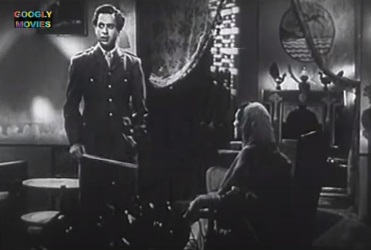
I have watched Chori Chori several times, and always with great satisfaction. Even though it starred Raj Kapoor (opposite Nargis, moreover), the film is not at all the sort of film RK was known for: this was the light-hearted romp that younger brother Shammi was to go on to make his own. A road trip, a pampered heiress, a romance. Lots of songs, great chemistry.

Continue reading

Tumse Achha Kaun Hai (1969)

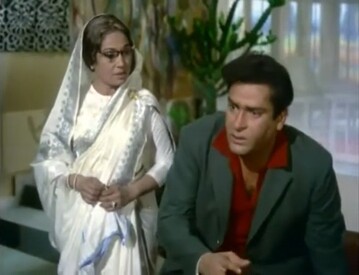
Lalita Pawar plays an ageing and very wealthy woman who employs a man (played by Shammi Kapoor) to reform her granddaughters, who are getting too wild for her liking. The man, poor and in desperate need of money to pay for the treatment of an ailing family member, takes up the offer, even though it will require him to pretend to be someone he’s not. In the process, he ends up falling in love with one of the granddaughters—much to the annoyance of the indignant grandmother.

This was the gist of the story of Professor (1962), though with one qualification: Shammi Kapoor’s Preetam in that film is initially hired just as a tutor for the younger brothers of the granddaughters; it’s only a little later that he’s also given the task of tutoring the young women. It was, as I’ve said on more than one occasion—and of course in my review of the film—a delightfully entertaining film, romantic and fun and with absolutely fabulous music.

Seven years later, Shammi Kapoor acted in another film with a somewhat similar plot. Here, in Tumse Achha Kaun Hai, he is Ashok, a musician; and Lalita Pawar plays Sarojini Devi, the very wealthy woman who approaches him with a proposition: that he take on the task of setting to rights her granddaughters, all three of whom (she feels) are a disgrace to Sarojini Devi.

Continue reading

Zindagi (1964)

The main reason I watched this film was because of the songs, which include some very good ones. And Vyjyanthimala, whom I invariably enjoy watching. The two male leads, Rajendra Kumar and Raj Kumar, are not favourites of mine, but they aren’t absolutely unbearable either. And there was a star cast of several other people I like, such as Prithviraj Kapoor and Helen. Ramanand Sagar, who wrote and directed Zindagi, also has to his credit one film I really like (Aankhen) and some (Aarzoo, Ghoonghat, Charas) that I don’t mind too much. I figured there might be enough here for me to enjoy.

The story begins with Beena (Vyjyanthimala) coming home to her mother (Leela Chitnis) with the news that she has found a job, finally. Ma is happy, until Beena tells her what the job is: Beena is now a theatre actress. Ma is very upset and goes into a long harangue of how it’s better to be poor than to be in the theatre; their name will be mud, blah blah.

Continue reading

Amrapali (1966)

Happy birthday, Vyjyanthimala! (it’s either her 90th birthday or her 87th today, it doesn’t seem very clear which, but anyway).

Among the recent books I’ve read is Advait Kottary’s Siddhartha: The Boy Who Became the Buddha, a fictionalized retelling of the story of the Buddha. While Siddhartha is the focal point of the narrative, several other important historical personages appear in the book, among them the nagarvadhu or courtesan of Vaishali, Amrapali. Amrapali is shown to have originally had a relationship with the ruler of Magadha, Bimbisara: so much so that she bears him a son, whom she is later compelled by circumstances to hand over to the Buddha to bring up. Bimbisara’s belligerent and headstrong son and heir, Ajatshatru, though he’s never seen ‘his father’s courtesan’ (as Kottary describes her), detests Amrapali.

… until he, injured in a way with Vaishali, impersonates a Lichhavi (native to Vaishali) soldier in order to escape with his life. Fate brings Ajatshatru and Amrapali together: she, thinking him to be Lichhavi, tends to his wounds and heals him, and they fall in love.

It’s been ages since I watched the Vyjyanthimala-Sunil Dutt Amrapali, and while I remembered some of the core elements, I’d forgotten much of it. As far as I remembered, the film had nothing whatsoever about Amrapali’s relationship with Bimbisara or her having a son with him. To be honest, I’d have been very surprised if that aspect of her life had been shown: it would have been far too bold for Hindi cinema, back then, to have a heroine who could have affairs with both father and son, and bear a child out of wedlock.

So I decided it was time to rewatch Amrapali, which begins in Magadha. Here, the king, Ajatshatru (Sunil Dutt), is in conference with his trusted advisor, friend, and Magadha’s commander-in-chief, Veer (Premnath). Ajatshatru is a hot-headed warmonger, and right now baying for the blood of the democratic Lichhavis, whose land, Vaishali, lies across the river to the north.

Continue reading

Nagina (1951)

This Gothic mystery story has an interesting claim to fame: it was the film Nutan wasn’t permitted to watch at the premiere, even though she starred in it.

Nutan had debuted in the film Hamari Beti (1950; it was directed by her mother, Shobhna Samarth) when she was all of fourteen. The following year, after having spent the intervening period at a finishing school in Switzerland, she was cast as the female lead in Ravindra Dave’s Nagina, which starred Dilip Kumar’s brother Nasir Khan. Nagina was released under an A certificate because it was considered too frightening for children; Nutan, then not even sixteen years old, was escorted to the premiere of the film by family friend Shammi Kapoor, but was not allowed in because she was underage.

The story begins [rather choppily; I wonder if this is the modern-day slash-and-burn style of video editing that’s reflected here, rather than the original film’s editing] with Srinath (Nasir Khan) having a conversation with his wheelchair-bound mother (Anwari Bai). As it later emerges from the story, Srinath’s father, a jeweller named Shyamlal, has been missing these last twelve years, ever since he was accused of having murdered the wife of a zamindar, Raiji, over a valuable gemstone (a ‘nagina’) set in a ring.

Continue reading

Ten of my favourite Shankar-Jaikishan songs

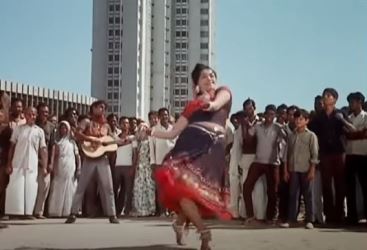
When it comes to Hindi film composer duos, for me there’s none greater than Shankar-Jaikishan. By no means the first (Husnlal Bhagatram, for one, predated them) and definitely not the last (there have been many others, from Laxmikant Pyarelal and Kalyanji Anandji to more recent duos like Anand-Milind), Shankar Jaikishan were unparalleled in the sheer quality of their work. They composed some of Hindi cinema’s best-loved tunes, all the way from Westernized club songs to ghazals, from dreamy love songs to peppy folk numbers. Versatility, finesse, and that ability to appeal to the common janta, to have ordinary folk humming their tunes: these were some traits which set Shankar-Jaikishan apart.

Continue reading

Love Marriage (1959)

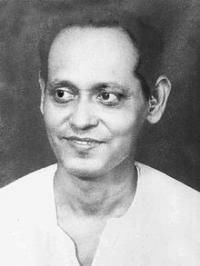
Today is the birth centenary of the Indian director, writer and producer Subodh Mukherji. While Mukherji doesn’t have a huge list of films to his name—barely a dozen—the majority of the films he did make proved to be very successful ones, big entertainers that had great music, starred beautiful people, and were generally good time-pass, if nothing else.

Born in Jhansi on April 1, 1921, Subodh Mukherji was jailed for three months in 1942 for his activities as part of the Indian freedom movement. Subsequently, at the behest of his family, he was made to go to Bombay to join his elder brother Sashadhar Mukherji (who had established Filmistan Studios along with Madan Mohan’s father, Rai Bahadur Chunilal; Ashok Kumar; and Gyan Mukherjee). It was for Filmistan that Subodh Mukherji made his first film, writing and directing Paying Guest (1957), though he also took time off in between to direct Munimji (1955). Through the late 50s and the 60s, Mukherji was to go on to write, produce, and/or direct several films that exemplified his philosophy of making films that told entertaining stories: Junglee (1961), Love Marriage (1959), Shagird (1967, starring Sashadhar Mukherji’s son, Joy Mukherji).

Continue reading

Sharaarat (1959)

It might surprise some of you to know just how many films I watch. No, not new ones, but old films, in the hope that I will find something worth reviewing for this blog. Perhaps one in five of those films gets reviewed, and that because either it’s worth recommending, or conversely, it’s worth warning people off. 

A lot of the Hindi films I watch, I watch because of the music. Occasionally (Duniya Jhukti Hai, Bank Manager, Chandni Chauk) there’s just one song that has prompted my viewing of the film, and the film itself turns out to be so ho-hum that I decide there’s not much point reviewing it. I assume, you see, that most people (unlike me) are sensible enough to not waste a couple of hours watching a film just because it has one good song. 

Sometimes, though, a film has a bunch of good songs, and a cast I have great hopes of. Then, even if it ends up being a bit of a dud, I feel obliged to review the film. Because I want to tell you: steer clear; despite the cast and despite the songs, this is really not worth your while. 

Also, in the case of Sharaarat, there was the fact that this film starred Meena Kumari. And, as I’ve seen from films like Miss Mary, Tamasha, Kohinoor, Azaad, etc, Meena Kumari was very good at comedy. Here, she was paired with Kishore Kumar. I settled down, hoping for some fun. Sharaarat, after all: that sounded promising. 

Continue reading

Chanda aur Bijli (1969)

Chanda aur Bijli is one of those films I’ve known about for a long time—because of a family anecdote that is centred around a song from this film. My sister, a toddler when Chanda aur Bijli was released, quickly fell in love with Bijli hoon main toh bijli. Her version of it, though, was somewhat different (and suggests a mind that dwelt rather heavily on food):

Bijli hoon main toh bijli
Bun khaake jab bhi nikli
Logon ke dil mein machhli
(And here she’d add a little line completely off her own bat: ‘Wohi machhli jo Baby ne khaayi thhi!’)

For those who don’t understand Hindi, that means:

Lightning; I am lightning,
When I went out after eating a bun,
There was a fish in people’s hearts
That same fish that Baby ate!

The original, of course, is a rather more predictable Hindi film song:

Bijli hoon main toh bijli
Bal khaake jab bhi nikli
Logon ke dil mein machli

(Lightning; I am lightning,
Every time I went out, tripping along,
I made people’s hearts trip)

Continue reading

Roop ki Rani Choron ka Raja (1961)

In 1956, Waheeda Rehman made her debut in Hindi cinema in CID, with Dev Anand (Waheeda wasn’t the heroine of CID—Shakila was—but she had a good and somewhat offbeat role as the vamp with a heart of gold). Over the next decade and a half or so, Waheeda and Dev Anand were to go on to act together in several more films, probably their most famous pairing being in the hugely popular Guide (1965).

I have watched, as far as I know, all of the Waheeda-Dev films over the years. The only one that (again, as far as I know) I hadn’t watched yet was this one. Time, I decided, to make amends for that.

As in many other films of his, Dev Anand in Roop ki Rani Choron ka Raja is a crook—a thief, to be precise. We are introduced to Chhagan (Dev) when he’s in a shady-looking dive, buying a bottle of booze. Shortly after, Chhagan is accosted by ‘Langad Deen’, a partly-crippled character (played by Jeevan), who has a bit of news for Chhagan: a steamer is about to begin the journey down the river to the pilgrimage spot of Shivsagar. Langad Deen has it on authority that among the people on board is a wealthy jeweller who is carrying a very valuable diamond to be offered up to the god Shiv at Shivsagar.

Continue reading