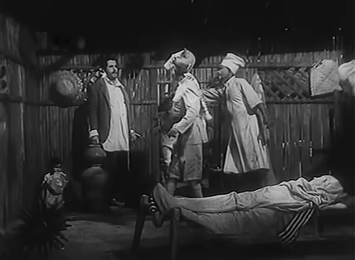
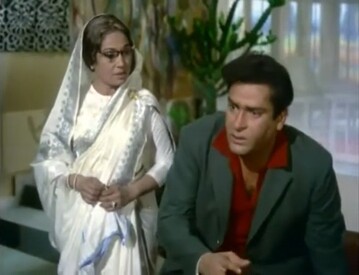
Biraj Bahu (1954)

I have to admit I have never watched this film in all my years of watching and blogging about old Hindi cinema. Part of the reason is, I suppose, that this film—directed by Bimal Roy—somehow always tends to get sidelined in all the praise that’s showered on his better-known works: Do Bigha Zameen, Bandini, Devdas, Parakh, Sujata, Madhumati… then, too, there’s the fact that Kamini Kaushal has never been one of my favourite actresses. I’ve always found her a little affected, her diction and expressions too exaggeratedly innocent.

Continue reading

Chori Chori (1956)

Happy 100th birthday to one of India’s greatest film makers, Raj Kapoor!

RK was born in Peshawar on December 14th, 1924. What can I say about him that hasn’t already been said or written, and by people much more erudite, well-informed, and more fond of RK’s cinema than I am? Yes; I will admit that I am not the greatest of Raj Kapoor’s fans, but let us keep the whys and the wherefores of that, the debates and the discussions, for another time. As Anu Warrier (of Conversations over Chai, not just a fellow blogger I admire hugely, but also an RK fan) said “I know there are RK films you like!”: and for RK’s birth centenary, I decided it was high time I finally reviewed an RK film that I particularly like.

I have watched Chori Chori several times, and always with great satisfaction. Even though it starred Raj Kapoor (opposite Nargis, moreover), the film is not at all the sort of film RK was known for: this was the light-hearted romp that younger brother Shammi was to go on to make his own. A road trip, a pampered heiress, a romance. Lots of songs, great chemistry.

Continue reading

Kundan (1955)

Some days ago, in this delightful post about chai in Hindi cinema, I came across a mention of Kundan. Aao hamaare hotal mein chai peeyoji garam-garam sounded so interesting that I bookmarked the film without even really checking to see what it was all about (though the cast, barring Nimmi—whom I often find very irritating—appealed to me). Then, just a couple of days later, Anu posted this wonderful tribute to Sohrab Modi, in which she listed Kundan as one of her favourite ten films directed by Modi. Adapted from Victor Hugo’s classic Les Miserables.

That sealed it. I had read Les Miserables a couple of years ago, and had been blown away by it: by the depth and width of it, the characterization, the sheer scope of it all. And now, it looked as if the universe was pushing me towards Kundan. I had to watch this one.

The story gets off to a flying start. Kundan (Sohrab Modi) is a very poor man who lives with his very ill sister and her little daughter Radha. Unable to earn [it’s not clear why, given that he looks able-bodied enough], a desperate Kundan finally steals a loaf of bread from a bakery and runs home to give it to Radha. Since he’s made no attempt to commit this theft in secrecy, the alarm has been raised and Kundan is arrested even as Radha is eating the loaf.

Continue reading

Tumse Achha Kaun Hai (1969)

Lalita Pawar plays an ageing and very wealthy woman who employs a man (played by Shammi Kapoor) to reform her granddaughters, who are getting too wild for her liking. The man, poor and in desperate need of money to pay for the treatment of an ailing family member, takes up the offer, even though it will require him to pretend to be someone he’s not. In the process, he ends up falling in love with one of the granddaughters—much to the annoyance of the indignant grandmother.

This was the gist of the story of Professor (1962), though with one qualification: Shammi Kapoor’s Preetam in that film is initially hired just as a tutor for the younger brothers of the granddaughters; it’s only a little later that he’s also given the task of tutoring the young women. It was, as I’ve said on more than one occasion—and of course in my review of the film—a delightfully entertaining film, romantic and fun and with absolutely fabulous music.

Seven years later, Shammi Kapoor acted in another film with a somewhat similar plot. Here, in Tumse Achha Kaun Hai, he is Ashok, a musician; and Lalita Pawar plays Sarojini Devi, the very wealthy woman who approaches him with a proposition: that he take on the task of setting to rights her granddaughters, all three of whom (she feels) are a disgrace to Sarojini Devi.

Continue reading

Sadhu aur Shaitan (1968)

Cinema looking at itself is not an uncommon feature; there have been several notable films, both in India (Kaagaz ke Phool, Sone ki Chidiya) as well as abroad (Cinema Paradiso, 8½, The Bad and the Beautiful, etc), which are about cinema and film-making. But this film, relatively obscure, really should be part of the annals, simply because of its sheer devotion to Hindi cinema. Not because it’s about film-making, not because there is even (as in Solvaan Saal), a single scene on the sets of a film. But because it celebrates Hindi cinema in so many ways, on so many levels.

Sadhu aur Shaitan begins by introducing us to the eponymous ‘sadhu’ of the story: Sadhuram (Om Prakash), a widower who lives with his two children Ganesh (Master Shahid) and Munni (Baby Fauzia), and the maid Ramdeyi (Dulari) who looks after home and the children. Sadhuram is a somewhat excessively ‘good and righteous’ man, the living image of piety (all a little over the top as far as I’m concerned, but at least he isn’t stuffy about his righteousness).

Continue reading

Ram aur Shyam (1967)

I wanted to watch a Dilip Kumar film to commemorate the life and career of this extraordinary actor. But which one? There are lots of iconic Dilip Kumar films that I have either seen long ago (Devdas, Footpath, Daag, Deedaar, Udan Khatola, Andaaz) and not reviewed on this blog, or which I’ve never seen (Tarana, Jugnu, Mela, Shaheed, Musaafir). I could watch a film I’d never seen before, but—knowing what a lot of Dilip Kumar’s early films are like—there was always a chance I’d run up against something depressing.

I finally decided to rewatch a film I’d seen years ago. A film that’s a good showcase of Dilip Kumar’s versatility, his ability to pull off comic roles as well as the tragic ones for which he was better known. Ram aur Shyam is an out-and-out entertainer, a film I’d watched and loved as a teenager, and which I knew for a fact would cheer me up.

Continue reading

Do Dil (1965)

Directed by Hrishikesh Mukherjee. Music by Hemant, lyrics by Kaifi Azmi.

That, by itself, would be enough to make me want to watch the film. But then, there was the fact I hadn’t known anything about Do Dil before other than its name. And that, for a Hrishikesh Mukherjee film, is odd. I guessed there must be something about it that was very forgettable.

There was only one way to find out: to watch the film for myself. With a crew like that, I figured that it would almost certainly not be outright awful.

Do Dil begins at a palace, with the death of the Maharaja (we are never shown this man). Some days later, though, a number of courtiers convene along with the Maharaja’s lawyer, who reads out the will. The Maharaja appoints his grand-nephew Kunwar Pratap Singh (Pran), who also happens to be the state’s senapati (commander) as his successor, though with Rani Indumati, the Maharaja’s sister (Durga Khote) as regent (this is all spelled out in very vague terms, so it’s not exactly clear what powers Ranima, as she’s known, will wield). Pratap Singh looks very pleased with himself…

The Maharaja's will is read out
Continue reading

Dil Diya Dard Liya (1966)

Despite its having a cast of several people whom I like a lot (Waheeda Rehman, Dilip Kumar, Pran, Rehman, Shyama), a music director whom I like a lot (Naushad) and being by no means an unknown film, Dil Diya Dard Liya is one I’d never got around to watching. Perhaps it is because I had been told by knowledgeable readers that it was based on Wuthering Heights—and I could imagine what a confluence of Wuthering Heights (dark, grim, with two thoroughly selfish and unlikeable leads) and typical Bollywood (melodramatic, with no lead capable of being anything but noble, even if it’s only in the final analysis)—would be like. Mishmash, hard to bear?

But when I posted a Naushad song list in tribute on Naushad’s birth centenary last year, several people mentioned the songs of Dil Diya Dard Liya, and I decided it was time to take the plunge. If for nothing else than Naushad’s music.

Continue reading

Khandaan (1942)

If Hindi cinema has ever had an iconic onscreen villain—not a villain in one film, but in film after film—it has got to be Pran. There have been other actors, from Wasti to Ajit, Ranjeet to Madan Puri, who have played memorable villains in films: but none, in my opinion, was quite able to sustain it and make it so much his forte that his own name became a synonym for villainy (it’s common knowledge that for many years, Indian parents refused to name baby boys Pran because of Pran).

In film after film, from period dramas like Halaku to comedies like a Half Ticket, from weep fests like Do Badan to supernatural stuff like Madhumati—Pran was in them all. With aplomb, he carried off every shade of villainy, whether it was the lisping and ruthless truck driver Mohan of Kashmir ki Kali or the tuneless dacoit-cum-gentleman of Munimji. He even did the occasional unusual role (as a doctor in Aah, and as a kotha frequenter in a cameo in Devdas), until, in the late 1960s, he began to play some sympathetic characters as well. From the cynical Malang Chacha of Upkaar, to Dev Anand’s long-lost brother in Johny Mera Naam, to his role in Zanjeer: Pran proved that he wasn’t just a great villain, he was a great actor, period.

Today would have been Pran’s hundredth birthday: he was born on February 12, 1920 in Delhi. And, to mark the occasion of his hundredth centenary, I thought I’d review a Pran film with a difference. Not Pran as the villain, but Pran as the hero. A young, gangly Pran, probably not even twenty-two years old yet, plays opposite a girlish Noorjehan in one of the first Hindi films to get a lot of pre-release publicity: Khandaan.

Continue reading

Pyaar Kiya Toh Darna Kya (1963)

For those who’ve been following this blog since pretty much its inception, or who’ve explored some of the older posts and specials on Dustedoff, it should come as no surprise that I am a fan of Shammi Kapoor. I have seen most of the star’s films from after his watershed year of 1957 (which was the year Tumsa Nahin Dekha was released, catapulting him to sudden stardom), and I’ve seen several from the early 1950s as well.

Finding a 60s (or late 50s) Shammi Kapoor film that I’ve not seen before is therefore a matter of singular excitement [or was; I have begun to realize, after several less than enjoyable experiences, that there is a reason most of these films aren’t better-known]. This time, when I came across Pyaar Kiya Toh Darna Kya, I approached it with caution. Pandit Mukhram Sharma’s name among the credits bolstered my hopes somewhat; he wrote some good stories, so I began thinking this might not be too bad.

Continue reading